The very talented Paolo Greco (of Adventure Fantasy Game fame - if you haven't checked it out, you owe it to yourself to get a copy - it's worth it for the reams of original spells alone, but it also features a wonderfully simple and effective combat-slash-skill system) is putting together a new issue of Burgs and Bailiffs, and I'm going to have an article in it!
It's going to be about calculating the costs of building your dream castle based on historical records. You'll be able to find out how much stone, wood, nails, sand, etc. it's going to take, how long it's going to take to build it, and how many guys you're going to need toiling a way (spoiler alert - it's a LOT).
Probably one of my favourite parts of D&D from when I was a kid was fantasizing about building castles - I must have spent hours poring over the castle cost charts in the old Basic/Expert/Companion books. I've been meaning for some time to do some research into what kind of resources it would really take to make the castles I've dreamed of, and I have to thank Paolo for getting my butt in gear and checking over my facts and figures.
So, look for the next installment of Burgs and Bailiffs soon, and if you haven't, check out the first Burgs and Bailiffs, and Adventure Fantasy Game:
http://tsojcanth.wordpress.com/2013/01/14/free-pdf-burgs-bailiffs/
http://tsojcanth.wordpress.com/2013/03/20/burgs-and-bailiffs-warfare-call-for-articles/
http://www.adventurefantasygame.com/
14 August 2013

31 July 2013
Real-world Weapons: The Arming Sword
Description
The "Arming Sword" is what I think most people think of (incorrectly) as a "longsword" or a "broadsword". The arming sword is the classic "knightly" sword of the High Middle Ages - a one-handed, cruciform, double-edged cut-and-thrust weapon with wide quillons and a heavy pommel.
Typically would be about 3' long, and about 2-2.5 lbs. Balance point is a few inches along the blade from the guard.
Misconceptions
Some of these have been dispelled before, but it bears repeating. One of the main myths around swords is that they were heavy - this is not so. An arming sword would weigh a little over 2lbs - no more than 2.5lbs.
They were not the dull, heavy, metal clubs some people seem to think they were - the arming sword is nimble and sharp. Now, the sword wouldn't be sharp like a razor blade is sharp - more like a chisel, but still sharp enough to easily cut an arm or leg off, decapitate someone - even cut them right in half. I'll have some caveats to this in my longsword article.
This is more of a general combat misconception, but sword combat doesn't take place at punching distance - two people aren't going to stand 4 feet apart bashing away at each other. Much of the fight will be at more like 10 feet, with a lot of fluid forward and back movement as the fight progresses.
A misconception I saw in a comment on another one of my posts was that you could wait for a sword swing to "go by", then rush in. This is not possible, as sword swings do not "go by". The finishing position of a sword strike that doesn't connect is with the point out in front of you, directed at your opponents neck or head.
Even if the sword did "go by", the nimbleness of a sword means that your rush would simply end with you having an arm cut off or being impaled.
Offence
The European cruciform sword is one of the most versatile weapons out there. It has cutting edges on both sides, and is straight and pointed for powerful thrusts. The quillons and pommel can be used to punch and strike - some swords even have sharpened quillons for more powerful quillon punches. In a pinch, it can even be used two-handed with one hand on the pommel, although it won't have the power of a true two-handed weapon, due to the limited leverage the off-hand will have.
The arming sword can be used with a shield or buckler (as detailed in MS I.33, the earliest known European martial arts manual) or alone (perhaps more common in a self-defense situation, described in Fiore's works).
I.33 does a good job of illustrating the way you fight with sword and buckler - keeping the two together, moving them as one weapon, using the buckler to cover your sword arm as you attack. You still are mainly using your sword to defend yourself - the buckler is there to help. I'll write more about shield combat when I get to shields. Suffice to say at this point that 1 point to Defense is undervaluing shields significantly.
Using the sword by itself opens the possibility of grappling with your off-hand - after you or your opponent make a successful cover, you may have an opportunity to grab the pommel of their sword, lock up their arm in a key or a bind, or even get really close and throw them to the ground.
Successful attacks with the sword are seeking to place a thrust in the head or neck, or less optimally in the chest (as the ribs are much harder to get through). With cuts, you can strike a near-vertical stroke down, looking to hit the head, or the base of the neck. Horizontal strokes can be aimed at the head, neck, or arms (preferably the sword arm, as chopping that off will instantly win the fight).
Rising strikes are typically aimed at the hand or arm, as their reach and power is less (and it doesn't take much force to lop off a finger), but they can easily be turned into a thrust at the end.
Defence
Defences with the sword are ideally seeking to displace the opponent's blade and make a strike or thrust at the same time. In the broadest sense, same counters same. A downward blow from the right shoulder will deflect a downward blow from the right shoulder. A thrust to the face counters a thrust to the face. If this was all there is to it, swordfighting would be a piece of cake - obviously, there are many other options.
Fiore describes a "universal defence" using the sword in one hand - stand with your right side to the enemy, sword down and back pointing past your left foot. Against any sword attack, you can step offline and cut into the attack, deflecting it and positioning yourself in a great place for a counterstroke. Interestingly enough, the starting position for this is basically leaning away from your opponent with your sword in its scabbard.
If a defence ends up with the swords bound (i.e. stopped edge-to-edge), you have a number of options - wind your sword around theirs and strike, grab their hand or arm with your off-hand to control their sword and strike, disarm them, slam them in the face with your pommel or quillon, a kick in the knee or groin...
The "Arming Sword" is what I think most people think of (incorrectly) as a "longsword" or a "broadsword". The arming sword is the classic "knightly" sword of the High Middle Ages - a one-handed, cruciform, double-edged cut-and-thrust weapon with wide quillons and a heavy pommel.
Typically would be about 3' long, and about 2-2.5 lbs. Balance point is a few inches along the blade from the guard.
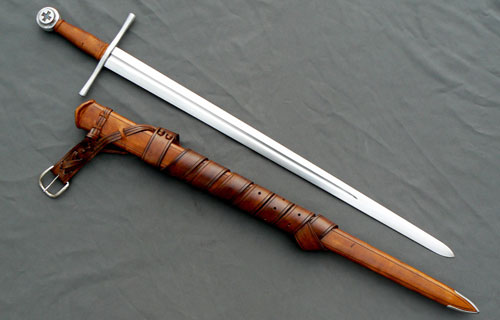 |
| A typical arming sword with scabbard, displaying the main features of a typical arming sword - tapered double-edged blade, straight quillons, heavy metal pommel. This sword is a replica of a typical Crusades-Era sword from Valiant Armoury, but arming swords around 1400 were substantially the same. Link to the Valiant Armoury page: http://www.valiant-armoury.com/catalog/txt_CF408.html |
Some of these have been dispelled before, but it bears repeating. One of the main myths around swords is that they were heavy - this is not so. An arming sword would weigh a little over 2lbs - no more than 2.5lbs.
They were not the dull, heavy, metal clubs some people seem to think they were - the arming sword is nimble and sharp. Now, the sword wouldn't be sharp like a razor blade is sharp - more like a chisel, but still sharp enough to easily cut an arm or leg off, decapitate someone - even cut them right in half. I'll have some caveats to this in my longsword article.
This is more of a general combat misconception, but sword combat doesn't take place at punching distance - two people aren't going to stand 4 feet apart bashing away at each other. Much of the fight will be at more like 10 feet, with a lot of fluid forward and back movement as the fight progresses.
A misconception I saw in a comment on another one of my posts was that you could wait for a sword swing to "go by", then rush in. This is not possible, as sword swings do not "go by". The finishing position of a sword strike that doesn't connect is with the point out in front of you, directed at your opponents neck or head.
Even if the sword did "go by", the nimbleness of a sword means that your rush would simply end with you having an arm cut off or being impaled.
Offence
The European cruciform sword is one of the most versatile weapons out there. It has cutting edges on both sides, and is straight and pointed for powerful thrusts. The quillons and pommel can be used to punch and strike - some swords even have sharpened quillons for more powerful quillon punches. In a pinch, it can even be used two-handed with one hand on the pommel, although it won't have the power of a true two-handed weapon, due to the limited leverage the off-hand will have.
The arming sword can be used with a shield or buckler (as detailed in MS I.33, the earliest known European martial arts manual) or alone (perhaps more common in a self-defense situation, described in Fiore's works).
I.33 does a good job of illustrating the way you fight with sword and buckler - keeping the two together, moving them as one weapon, using the buckler to cover your sword arm as you attack. You still are mainly using your sword to defend yourself - the buckler is there to help. I'll write more about shield combat when I get to shields. Suffice to say at this point that 1 point to Defense is undervaluing shields significantly.
Using the sword by itself opens the possibility of grappling with your off-hand - after you or your opponent make a successful cover, you may have an opportunity to grab the pommel of their sword, lock up their arm in a key or a bind, or even get really close and throw them to the ground.
Successful attacks with the sword are seeking to place a thrust in the head or neck, or less optimally in the chest (as the ribs are much harder to get through). With cuts, you can strike a near-vertical stroke down, looking to hit the head, or the base of the neck. Horizontal strokes can be aimed at the head, neck, or arms (preferably the sword arm, as chopping that off will instantly win the fight).
Rising strikes are typically aimed at the hand or arm, as their reach and power is less (and it doesn't take much force to lop off a finger), but they can easily be turned into a thrust at the end.
Defence
Defences with the sword are ideally seeking to displace the opponent's blade and make a strike or thrust at the same time. In the broadest sense, same counters same. A downward blow from the right shoulder will deflect a downward blow from the right shoulder. A thrust to the face counters a thrust to the face. If this was all there is to it, swordfighting would be a piece of cake - obviously, there are many other options.
Fiore describes a "universal defence" using the sword in one hand - stand with your right side to the enemy, sword down and back pointing past your left foot. Against any sword attack, you can step offline and cut into the attack, deflecting it and positioning yourself in a great place for a counterstroke. Interestingly enough, the starting position for this is basically leaning away from your opponent with your sword in its scabbard.
If a defence ends up with the swords bound (i.e. stopped edge-to-edge), you have a number of options - wind your sword around theirs and strike, grab their hand or arm with your off-hand to control their sword and strike, disarm them, slam them in the face with your pommel or quillon, a kick in the knee or groin...
28 July 2013
Mortal Wounds and the Double-kill
I read an absolutely fascinating paper recently in SPADA 2, by Richard Swinney and Scott Crawford. It addresses the realities of how long people can live and continue fighting after suffering catastrophic injuries.
The conclusion of the authors is that the human body is significantly tougher than is commonly thought. To whit, they address a few common scenarios, and give a typical case history of a victim.
These include arm amputation, serious head injury with brain involvement, abdominal and thoracic wounds with complete penetration, severed arteries, and pain tolerance for massive lacerations.
In every case, the authors find that the victim of these serious injuries would generally not be immediately incapacitated, and would likely be able to make - at the very least - a few desperate attacks on their wounder, likely ending the fight in a double kill.
They cite that it was common, during the dueling craze in France around 1600, that both duelists would be badly wounded or killed in the fight, or that one would be killed and the other badly wounded.
Some of the more noteworthy case studies they present I will gloss here briefly. The authors stress that these cases are TYPICAL, and not exceptions to the rule. In their research and practice (one of the authors is a military/emergency physician), people are routinely able to continue functioning at or near full capacity for minutes or hours after receiving what would seem like an incapacitating wound.
A man whose arm was severed in a log splitter shut off the machine and fetched his wife. They fashioned a tourniquet for his arm, and drove to the hospital (they did NOT see the need to call an ambulance). Along the way, they stopped to pick up coffee.
A man whose skull was pierced by a hammer, driving bone into the brain, was in complete possession of his senses, and fully capable of fighting - the only effect was he couldn't speak. He could read and write fluently, and had full motor control, and was thinking clearly.
A man whose skull was split open by a halberd stroke (right into the centre of his brain) not only wasn't killed outright, but walked two hundred yards to the physician who dressed his wounds. He died only after some days, but was able to move about, speak, and was in possession of his senses up until his death.
There were two cases of people being pierced completely through the belly with a sword - in one case, the victim removed the sword himself (and was fine after extensive medical treatment - this was in the 1500s) and the other, the victim did not seek medical attention for some hours after the wound, as it did not seem serious to him (this was contemporary).
Conclusions
It's really, really hard to kill someone stone dead in a single cut. The effect of this is that double-kills are actually a very common scenario in unarmoured combat.
I'll be following up on this post with what this might mean for gaming in the next couple of posts.
The conclusion of the authors is that the human body is significantly tougher than is commonly thought. To whit, they address a few common scenarios, and give a typical case history of a victim.
These include arm amputation, serious head injury with brain involvement, abdominal and thoracic wounds with complete penetration, severed arteries, and pain tolerance for massive lacerations.
In every case, the authors find that the victim of these serious injuries would generally not be immediately incapacitated, and would likely be able to make - at the very least - a few desperate attacks on their wounder, likely ending the fight in a double kill.
They cite that it was common, during the dueling craze in France around 1600, that both duelists would be badly wounded or killed in the fight, or that one would be killed and the other badly wounded.
Some of the more noteworthy case studies they present I will gloss here briefly. The authors stress that these cases are TYPICAL, and not exceptions to the rule. In their research and practice (one of the authors is a military/emergency physician), people are routinely able to continue functioning at or near full capacity for minutes or hours after receiving what would seem like an incapacitating wound.
A man whose arm was severed in a log splitter shut off the machine and fetched his wife. They fashioned a tourniquet for his arm, and drove to the hospital (they did NOT see the need to call an ambulance). Along the way, they stopped to pick up coffee.
A man whose skull was pierced by a hammer, driving bone into the brain, was in complete possession of his senses, and fully capable of fighting - the only effect was he couldn't speak. He could read and write fluently, and had full motor control, and was thinking clearly.
A man whose skull was split open by a halberd stroke (right into the centre of his brain) not only wasn't killed outright, but walked two hundred yards to the physician who dressed his wounds. He died only after some days, but was able to move about, speak, and was in possession of his senses up until his death.
There were two cases of people being pierced completely through the belly with a sword - in one case, the victim removed the sword himself (and was fine after extensive medical treatment - this was in the 1500s) and the other, the victim did not seek medical attention for some hours after the wound, as it did not seem serious to him (this was contemporary).
Conclusions
It's really, really hard to kill someone stone dead in a single cut. The effect of this is that double-kills are actually a very common scenario in unarmoured combat.
I'll be following up on this post with what this might mean for gaming in the next couple of posts.
30 June 2013
Real-World Weapons: The Axe and Mace
Difficulties
I must admit, I am significantly less familiar with the short unbalanced weapons than I am with, say, the sword and spear. Additionally, there are no period texts detailing the use of the mace or the short axe. Dagger, sword, spear, poleaxe, yes - axe and mace, no. So much of what we can say about these weapons is speculative.
What we can do is look at surviving specimens and accurate reproductions to get a sense of what the weapons were like, physically.
Descriptions
First off, these weapons are shorter than I had previously thought - one handed maces don't seem to vary much from the 24" mark. They're also lighter than I had thought - rarely more than 3 lbs, and often only 2 lbs - sometimes less. The same goes for axes, although they tend to be a little smaller and lighter still!
The balance point ranges from the middle of the weapon to a little past the middle (i.e. closer to the head). It looks like the balance point would be further, but there you are.
This all contributes to making maces and axes significantly handier in combat than you might expect.
Mace - Description
The difference between a mace and a club is subtle. To my mind, the defining features of the mace are two-fold: all-metal construction, and the use of flanges or knobs on the head.
Length: 20-30"
Weight: 2lb
Balance point: 2/3 up from butt end.
Mace Variation - Morning Star
The morning star is simply a mace with spikes instead of knobs or flanges, especially if there is one larger spike at the very top for thrusting.
Axe Description
Military axes had very small, thin, light heads compared to woodcutting axes or hatchets. The head would also often have a cut-out between the blade and haft, allowing for the axe to be used for hooking, and reducing weight while maximizing cutting area.
Length:18"-30"
Weight: 1-2lb
Axe Variation - Military Pick / Warhammer
A military pick or warhammer are basically just piercing or bludgeoning versions of the axe. Some axes even incorporate a pick on their back end, and most warhammers have a hammer side and a pick side. Otherwise, they are very similar to an axe.
Misconceptions
It seems to be a common misconception that maces and axes were big, heavy things that dealt damage through their weight and brute force. The reality is that they were usually smaller and lighter than swords, and relied as much on the speed of the swing as on their unbalanced weight distribution.
Offence
Archaeological evidence shows that people killed by axe blows were typically struck from above, leading me to believe that fendente (i.e. overhead strikes) were more typically used with these weapons than mezzane (strikes parallel with the ground). Logically, this makes sense - gravity would be pulling the heavy head of the weapon down, lending more force to the blow for free.
The other common injury with axes seen is leg injuries. This is likely because axes were used with shields - two fighters with shields apparently find opportunities to hook the axe under the opponent's shield. Later treatises of the sword don't describe leg strikes - they focus on attacks to the head, neck, and weapon arm.
Defence
If using an axe or mace with your other hand empty, you could possibly do some dagger/baton defences with the shaft. The problem immediately apparent in adapting these plays is that axes - while they can thrust - are not suited for the devastating thrusts to the vitals that daggers are capable of.
It may be possible to do some of the sword defences, but the short shaft and lack of guard would limit your options there. While handier than you'd think, an axe or mace is not going to be a great option for your only defensive weapon.
Except in urgent situations, typically an axe or mace would be used with a shield. This makes up for the lack of agility compared with a sword - at least compared to a sword without a shield.
I must admit, I am significantly less familiar with the short unbalanced weapons than I am with, say, the sword and spear. Additionally, there are no period texts detailing the use of the mace or the short axe. Dagger, sword, spear, poleaxe, yes - axe and mace, no. So much of what we can say about these weapons is speculative.
What we can do is look at surviving specimens and accurate reproductions to get a sense of what the weapons were like, physically.
Descriptions
 |
| A standard European mace. This is likely a little out-of-period for me, likely c. 1450-1500, but is substantially similar to earlier models. Image courtesy of Nazanian and Wikimedia Commons. |
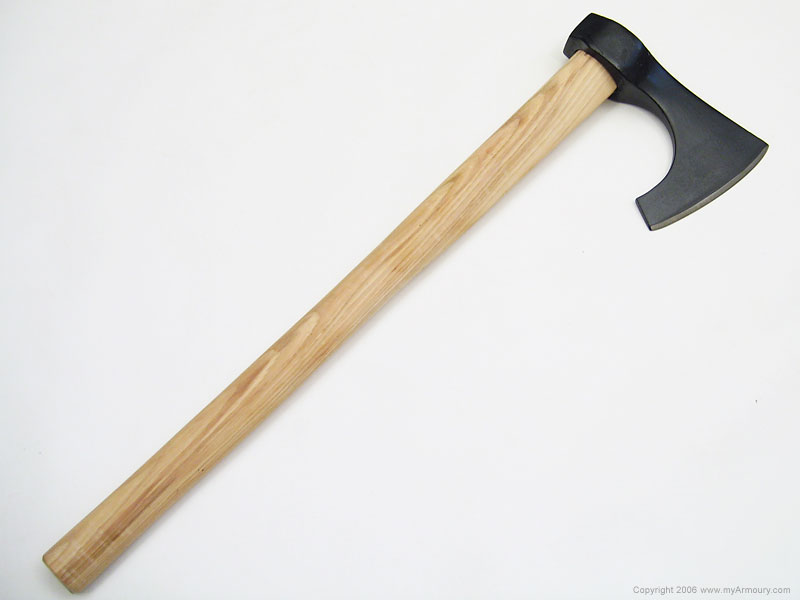 |
| Replica battleaxe, based on an archeological find in Norway. Reasonably typical of battleaxes in general. Photo from myArmoury.com, axe by Arms & Armour. |
First off, these weapons are shorter than I had previously thought - one handed maces don't seem to vary much from the 24" mark. They're also lighter than I had thought - rarely more than 3 lbs, and often only 2 lbs - sometimes less. The same goes for axes, although they tend to be a little smaller and lighter still!
The balance point ranges from the middle of the weapon to a little past the middle (i.e. closer to the head). It looks like the balance point would be further, but there you are.
This all contributes to making maces and axes significantly handier in combat than you might expect.
Mace - Description
The difference between a mace and a club is subtle. To my mind, the defining features of the mace are two-fold: all-metal construction, and the use of flanges or knobs on the head.
Length: 20-30"
Weight: 2lb
Balance point: 2/3 up from butt end.
Mace Variation - Morning Star
The morning star is simply a mace with spikes instead of knobs or flanges, especially if there is one larger spike at the very top for thrusting.
Axe Description
Military axes had very small, thin, light heads compared to woodcutting axes or hatchets. The head would also often have a cut-out between the blade and haft, allowing for the axe to be used for hooking, and reducing weight while maximizing cutting area.
Length:18"-30"
Weight: 1-2lb
Axe Variation - Military Pick / Warhammer
A military pick or warhammer are basically just piercing or bludgeoning versions of the axe. Some axes even incorporate a pick on their back end, and most warhammers have a hammer side and a pick side. Otherwise, they are very similar to an axe.
Misconceptions
It seems to be a common misconception that maces and axes were big, heavy things that dealt damage through their weight and brute force. The reality is that they were usually smaller and lighter than swords, and relied as much on the speed of the swing as on their unbalanced weight distribution.
Offence
Archaeological evidence shows that people killed by axe blows were typically struck from above, leading me to believe that fendente (i.e. overhead strikes) were more typically used with these weapons than mezzane (strikes parallel with the ground). Logically, this makes sense - gravity would be pulling the heavy head of the weapon down, lending more force to the blow for free.
The other common injury with axes seen is leg injuries. This is likely because axes were used with shields - two fighters with shields apparently find opportunities to hook the axe under the opponent's shield. Later treatises of the sword don't describe leg strikes - they focus on attacks to the head, neck, and weapon arm.
Defence
 |
| A dagger play that might be usable with an axe. From the Pissani-Dossi MS of Fiore Dei Liberi's manual. |
 |
| Two more dagger plays that might work with an axe or mace. From the Paris Manuscript by Fiore Dei Liberi. |
If using an axe or mace with your other hand empty, you could possibly do some dagger/baton defences with the shaft. The problem immediately apparent in adapting these plays is that axes - while they can thrust - are not suited for the devastating thrusts to the vitals that daggers are capable of.
It may be possible to do some of the sword defences, but the short shaft and lack of guard would limit your options there. While handier than you'd think, an axe or mace is not going to be a great option for your only defensive weapon.
Except in urgent situations, typically an axe or mace would be used with a shield. This makes up for the lack of agility compared with a sword - at least compared to a sword without a shield.
28 June 2013
Weapon Types, or Why Exhaustive Weapons Charts Are Unnecessary
A comment by JDJarvis brought to mind that I've never talked about why I use the weapons I use on my charts and examples. There are two main reasons.
Firstly, I'm most interested in the 14th century and early 15th century. Call it 1325-1425. The weapons I list are the most common weapons of that era - the dagger, the arming sword, the longsword, the mace, the axe, the spear, and the poleaxe.
Secondly, I intended this list to be broadly applicable, despite its brevity. I believe the user of the system should be able to easily extrapolate new weapons, as with these few weapons, I've covered all the archetypes of melee weapons:
I would put the Roman shortsword into the "small" category (some might argue for it being in the "balanced one-handed" category, but that category implies more defensiveness than a shortsword provides), the warhammer clearly is unbalanced one-handed, and the cutlass clearly balanced one-handed.
Halberd? Unbalanced two-handed. Tomahawk? Unbalanced one-handed. Club? Unbalanced one-handed. Rapier? Balanced one-handed. Scimitar? Balanced one-handed. Falchion? Balanced one-handed.
When I see the weapons lists in many RPGs, lists that often take up whole pages, I shake my head. Do we really need to mechanically differentiate between a cutlass, a scimitar, a falchion, and an arming sword? Aren't they all pretty much bladed weapons, about 3' long, with a balance point about 4" from the grip? Isn't just one example sufficient? I feel the huge charts of weapons clutter up the book, and confuse new players.
Perhaps a compromise in a finished product would be to list the few weapons I have, briefly explain the rationale behind the categories, and provide a simple (but fairly exhaustive) list in an appendix of how all other medieval(ish) weapons fit into the system.
Firstly, I'm most interested in the 14th century and early 15th century. Call it 1325-1425. The weapons I list are the most common weapons of that era - the dagger, the arming sword, the longsword, the mace, the axe, the spear, and the poleaxe.
Secondly, I intended this list to be broadly applicable, despite its brevity. I believe the user of the system should be able to easily extrapolate new weapons, as with these few weapons, I've covered all the archetypes of melee weapons:
- small (dagger)
- less than 18" or so in size
- balanced one-handed (arming sword)
- balance point within 4" of hand
- nimble, defensive
- unbalanced one-handed (mace, axe)
- balance point around middle of weapon or further from grip
- good against armour
- less nimble, less defensive
- balanced two-handed (longsword, spear)
- balance point near the hands at one end OR
- balance point near middle of weapon
- strong offense and defense
- unbalanced two-handed (poleaxe)
- balance point closer to "head" of weapon
- good against armour
- strong offense and defense
I would put the Roman shortsword into the "small" category (some might argue for it being in the "balanced one-handed" category, but that category implies more defensiveness than a shortsword provides), the warhammer clearly is unbalanced one-handed, and the cutlass clearly balanced one-handed.
Halberd? Unbalanced two-handed. Tomahawk? Unbalanced one-handed. Club? Unbalanced one-handed. Rapier? Balanced one-handed. Scimitar? Balanced one-handed. Falchion? Balanced one-handed.
When I see the weapons lists in many RPGs, lists that often take up whole pages, I shake my head. Do we really need to mechanically differentiate between a cutlass, a scimitar, a falchion, and an arming sword? Aren't they all pretty much bladed weapons, about 3' long, with a balance point about 4" from the grip? Isn't just one example sufficient? I feel the huge charts of weapons clutter up the book, and confuse new players.
Perhaps a compromise in a finished product would be to list the few weapons I have, briefly explain the rationale behind the categories, and provide a simple (but fairly exhaustive) list in an appendix of how all other medieval(ish) weapons fit into the system.
26 June 2013
Real-World Weapons - The Dagger
I'm starting a new series on Real-World Weapons - i.e. the weapons we know and love from D&D in a real-world context. I hope that this series will illuminate the use of these weapons to the reader, enabling players to employ more varied, effective, and realistic tactics in battle, and helping DMs deliver vivid fight scenes that have the ring of truth to them.
I'm starting this series off with a weapon that doesn't get a lot of love (outside of Magic User circles) - the dagger. I'll be continuing on with the short, unbalanced weapons (axes and maces), then the swords (arming and long), and eventually the polearms (spear and poleaxe). I may do more later on, but most other weapons are pretty similar to one of these - enough that they can probably be treated the same mechanically.
Description
The medieval dagger of the period was about the size of a really big carving knife - the blade would be about 12"-18" long, with an extremely stiff blade. It's primary purpose was piercing, but it would typically have at least one sharp or semi-sharp edge.
Offense
Daggers typically deal low damage in RPGs, to distinguish them from the bigger weapons. I would posit that the 0e system of d6 across the board is not that far off. All Medieval weapons were more than capable of killing a normal, unarmoured man outright in a single blow, and this is how Oe works.
The 12" blade of a dagger can do some really serious damage to the human body. A blow to the head will pierce the brain, likely instantly killing the victim. Neck shots will sever arteries, cut the windpipe, or damage the spinal cord. Blows to the trunk are typically less useful, as the ribcage is pretty tough, but a blow that comes down through the collarbone or between two ribs could easily puncture a lung. Stabs to the abdomen can pierce the liver, kidneys, or other vital organs, leading to rapid death from internal bleeding.
That said, many of the blows from a dagger would be to the hands and arms, where they would be painful and dangerous in the long run (i.e. slow bleeding and infections), they likely wouldn't put you out of the fight. Glancing blows will slice the victim up, but again, likely not enough to put the person out of the fight.
This is my justification for giving the dagger 2d6-TL (2d6 Take Lowest) - enough that it can be very dangerous, but blows from it typically will not kill you.
Usage Vs. Armour
The Medieval dagger was also a valid tool against an armoured opponent. Its stiff blade and sharp point made it ideal for forcing through chain mail, and it can still be used in a grapple once other weapons have been abandoned.
In a close fight between armoured opponents with daggers, each will be seeking a weak point to drive it in, and there are a few choice targets. Depending on the helmet, there may be some great targets on the head.
If the helm is unvisored, like the popular kettlehelm or early bascinets, the face has only thin bone between blade and brain, and is an excellent target.
If the helm is visored, like the popular hounskull bascinet, it may be possible to open the visor and attack the face.
Lastly, if the helm is one solid piece, like a greathelm, the eyeslits can be a target. This is probably most practical if the victim is pinned on the ground, limiting their head mobility, as the eyeslit is a very small target, and they often had flanges to direct thrusts away from them.
After head strikes, the neck is another good target. In-period, the neck was often defended by a plate gorget (which would be more or less impermeable), with or without an aventail of mail around it. In a very close grapple, the attacker might be able to lift the back of the aventail, and get his dagger in the back of the neck, severing the spine or major arteries, or plunging the blade down in the hopes of hitting the heart or lung.
Barring any of those options, the armpits were typically only armoured with chain, which a dagger could be forced through.
Defense
While the dagger is rather small, it is not useless for defending yourself - anything that you can directly control an enemy weapon with is better than nothing! In fact, you can make most of the dagger defenses with any kind of similarly-shaped object - a stick, for example.
I've rated the dagger's defensiveness as low, because it is so small it's easy to screw up your defense, and it can be overborne by powerful weapons like the poleaxe.
A defender with a dagger facing someone with a superior weapon would be trying to do a few things, typically.
Controlling the opponent's weapon is always the first priority, as killing them is little good to you if they kill you at the same time. The dagger doesn't offer the leverage of a sword, or the reach to strike from the bind (i.e. weapons crossed). Therefore the person with the dagger will likely try to transfer control of the opponent's weapon from the dagger to their offhand after parrying an attack.
From there, they can seek a lock (like a key or armbar), a disarm (most viable against a one-handed weapon), probably all combined with an attempt to maneuver in beside or behind the opponent for an opportunity for one of the lethal strikes I described above.
I'm starting this series off with a weapon that doesn't get a lot of love (outside of Magic User circles) - the dagger. I'll be continuing on with the short, unbalanced weapons (axes and maces), then the swords (arming and long), and eventually the polearms (spear and poleaxe). I may do more later on, but most other weapons are pretty similar to one of these - enough that they can probably be treated the same mechanically.
Description
The medieval dagger of the period was about the size of a really big carving knife - the blade would be about 12"-18" long, with an extremely stiff blade. It's primary purpose was piercing, but it would typically have at least one sharp or semi-sharp edge.
 | ||
| Rondel Dagger c. 1350 found in the Thames River, London - image from Wikimedia Commons, courtesy of Dana Williams |
Offense
Daggers typically deal low damage in RPGs, to distinguish them from the bigger weapons. I would posit that the 0e system of d6 across the board is not that far off. All Medieval weapons were more than capable of killing a normal, unarmoured man outright in a single blow, and this is how Oe works.
The 12" blade of a dagger can do some really serious damage to the human body. A blow to the head will pierce the brain, likely instantly killing the victim. Neck shots will sever arteries, cut the windpipe, or damage the spinal cord. Blows to the trunk are typically less useful, as the ribcage is pretty tough, but a blow that comes down through the collarbone or between two ribs could easily puncture a lung. Stabs to the abdomen can pierce the liver, kidneys, or other vital organs, leading to rapid death from internal bleeding.
That said, many of the blows from a dagger would be to the hands and arms, where they would be painful and dangerous in the long run (i.e. slow bleeding and infections), they likely wouldn't put you out of the fight. Glancing blows will slice the victim up, but again, likely not enough to put the person out of the fight.
This is my justification for giving the dagger 2d6-TL (2d6 Take Lowest) - enough that it can be very dangerous, but blows from it typically will not kill you.
Usage Vs. Armour
The Medieval dagger was also a valid tool against an armoured opponent. Its stiff blade and sharp point made it ideal for forcing through chain mail, and it can still be used in a grapple once other weapons have been abandoned.
In a close fight between armoured opponents with daggers, each will be seeking a weak point to drive it in, and there are a few choice targets. Depending on the helmet, there may be some great targets on the head.
If the helm is unvisored, like the popular kettlehelm or early bascinets, the face has only thin bone between blade and brain, and is an excellent target.
If the helm is visored, like the popular hounskull bascinet, it may be possible to open the visor and attack the face.
Lastly, if the helm is one solid piece, like a greathelm, the eyeslits can be a target. This is probably most practical if the victim is pinned on the ground, limiting their head mobility, as the eyeslit is a very small target, and they often had flanges to direct thrusts away from them.
After head strikes, the neck is another good target. In-period, the neck was often defended by a plate gorget (which would be more or less impermeable), with or without an aventail of mail around it. In a very close grapple, the attacker might be able to lift the back of the aventail, and get his dagger in the back of the neck, severing the spine or major arteries, or plunging the blade down in the hopes of hitting the heart or lung.
Barring any of those options, the armpits were typically only armoured with chain, which a dagger could be forced through.
Defense
.jpg/417px-Getty_Ms._Ludwig_XV_13_19r_-_Fiore_dei_Liberi_-_Combat_with_Dagger_and_Sword_-_Google_Art_Project_(6910100).jpg) |
| Plays of sword and dagger, from the Getty MS Ludwig XV 13, by the Master Fiore Dei Liberi c. 1410. |
While the dagger is rather small, it is not useless for defending yourself - anything that you can directly control an enemy weapon with is better than nothing! In fact, you can make most of the dagger defenses with any kind of similarly-shaped object - a stick, for example.
I've rated the dagger's defensiveness as low, because it is so small it's easy to screw up your defense, and it can be overborne by powerful weapons like the poleaxe.
A defender with a dagger facing someone with a superior weapon would be trying to do a few things, typically.
Controlling the opponent's weapon is always the first priority, as killing them is little good to you if they kill you at the same time. The dagger doesn't offer the leverage of a sword, or the reach to strike from the bind (i.e. weapons crossed). Therefore the person with the dagger will likely try to transfer control of the opponent's weapon from the dagger to their offhand after parrying an attack.
From there, they can seek a lock (like a key or armbar), a disarm (most viable against a one-handed weapon), probably all combined with an attempt to maneuver in beside or behind the opponent for an opportunity for one of the lethal strikes I described above.
24 June 2013
Confined Spaces
Edit: updated Longsword length to be 4', a better estimate than 3.5'.
Previously, I'd talked about reach in the abstract, without considering the space you're in. How do we deal with the restrictions imposed on fighting by a confined space? I've touched on this issue here before, in my post Dungeoneering Tools: The Spear, but I'd like to develop something a bit more general, as the subject of confined spaces obviously affects more than just the spear.
Confined Spaces
What constitutes a confined space is going to vary based on what kind of weapon you're used. A space that is "confined" for a spear could be spacious for a dagger. There are also some weapons that have options for how to fight with them - something like a longsword can be held with one or two hands on the hilt, or with one hand on the hilt and one hand on the blade (called "halfsword"). A spear can be gripped in thirds (the usual way for single combat) or with one or two hands down at the butt (for formation combat).
See below for a detailed and simplified chart of how much space different weapons need to be used effectively.
Effects of Confined Spaces
If you don't have enough space (in any dimension) for using your weapon properly, you don't get any Defense or Attack bonus for your weapon. Also, any rolls above 10 on your d20 attack roll count as a 10.
If the space is too small to wield the weapon at all (e.g. trying to use a 7' spear in a 6'x6' closet), obviously you can't use it at all.
Weapon Reach
The reach of a weapon is equal to: the length of the weapon past the hand + the length of the arm + the length of one step + a little bit for body positioning. Anything within the reach of the weapon is a potential target.
Footwork
In addition to the length of the weapon, there's also the footwork required for using it effectively. This is fairly consistent across weapons, and can probably be generalized to about one step per round in any direction.
Weapon Usage Style
There's also the matter of usage style. Spear, longsword, and poleaxe immediately occur as having a couple of options for how to use them.
Spears, poleaxes, and longswords can be held in thirds (i.e. each hand 1/3 from the respective end) or at the butt (i.e. both hands down near the end). Holding a spear by the butt gives it great reach, but limits its offensive and defensive power. Holding a spear in thirds gives its attacks and parries great power, and opens up the possibility of using the spear as a lever when grappling (e.g. a missed thrust to the head turns into an attempt to knock the person down by hooking the spear around behind their head and pulling them down).
Poleaxes and longswords can be swung when held at the butt, which for poleaxes obviously needs a great deal of room.
Space Requirements
Most weapons are going to need a radius of their reach around them, and probably space above them (approximately weapon length + shoulder height) above them.
Let's categorize weapons:
Detailed table:
And, an extremely simplified version, because that's a lot of fiddly numbers:
For this table, S / M / L:
Reach: 8' / 10' / 12'
Width: 8' / 12' / 16'
Height: 6' / 8' / 10'
Previously, I'd talked about reach in the abstract, without considering the space you're in. How do we deal with the restrictions imposed on fighting by a confined space? I've touched on this issue here before, in my post Dungeoneering Tools: The Spear, but I'd like to develop something a bit more general, as the subject of confined spaces obviously affects more than just the spear.
Confined Spaces
What constitutes a confined space is going to vary based on what kind of weapon you're used. A space that is "confined" for a spear could be spacious for a dagger. There are also some weapons that have options for how to fight with them - something like a longsword can be held with one or two hands on the hilt, or with one hand on the hilt and one hand on the blade (called "halfsword"). A spear can be gripped in thirds (the usual way for single combat) or with one or two hands down at the butt (for formation combat).
See below for a detailed and simplified chart of how much space different weapons need to be used effectively.
Effects of Confined Spaces
If you don't have enough space (in any dimension) for using your weapon properly, you don't get any Defense or Attack bonus for your weapon. Also, any rolls above 10 on your d20 attack roll count as a 10.
If the space is too small to wield the weapon at all (e.g. trying to use a 7' spear in a 6'x6' closet), obviously you can't use it at all.
Weapon Reach
The reach of a weapon is equal to: the length of the weapon past the hand + the length of the arm + the length of one step + a little bit for body positioning. Anything within the reach of the weapon is a potential target.
Footwork
In addition to the length of the weapon, there's also the footwork required for using it effectively. This is fairly consistent across weapons, and can probably be generalized to about one step per round in any direction.
Weapon Usage Style
There's also the matter of usage style. Spear, longsword, and poleaxe immediately occur as having a couple of options for how to use them.
Spears, poleaxes, and longswords can be held in thirds (i.e. each hand 1/3 from the respective end) or at the butt (i.e. both hands down near the end). Holding a spear by the butt gives it great reach, but limits its offensive and defensive power. Holding a spear in thirds gives its attacks and parries great power, and opens up the possibility of using the spear as a lever when grappling (e.g. a missed thrust to the head turns into an attempt to knock the person down by hooking the spear around behind their head and pulling them down).
Poleaxes and longswords can be swung when held at the butt, which for poleaxes obviously needs a great deal of room.
Space Requirements
Most weapons are going to need a radius of their reach around them, and probably space above them (approximately weapon length + shoulder height) above them.
Let's categorize weapons:
Detailed table:
Weapon
|
Length (effective)
|
Max Reach
(length + arm + step + lean)
|
Min width
(length x 2 + step x 2 OR step x 2 for thrusting-only weapons)
|
Min Height (6' wielder)
(length+shoulder height)
|
Dagger
|
1
|
8
|
8
|
6
|
Axe/Mace
|
2
|
9
|
10
|
7
|
Arming Sword
|
3
|
10
|
12
|
8
|
Long Sword
|
4
|
11
|
14
|
9
|
Long Sword (halfsword)
|
4 (1)
|
8
|
8
|
7
|
Spear (thirds)
|
7 (3)
|
10
|
12-16
|
8-11
|
Spear (butt)
|
7 (5)
|
12
|
6
|
6
|
Poleaxe
|
6 (2-4)
|
9-11
|
14
|
9
|
And, an extremely simplified version, because that's a lot of fiddly numbers:
Weapon
|
Length (effective)
|
Max Reach
|
Min width
|
Min Height
|
Dagger
|
1
|
S
|
S
|
S
|
Axe/Mace
|
2
|
S
|
S
|
M
|
Arming Sword
|
3
|
M
|
M
|
M
|
Long Sword
|
4
|
M
|
M
|
M
|
Long Sword (halfsword)
|
4 (1)
|
S
|
S
|
S
|
Spear (thirds)
|
7 (3)
|
M
|
L
|
L
|
Spear (butt)
|
7 (5)
|
L
|
S
|
S
|
Poleaxe
|
6 (2-4)
|
M
|
L
|
L
|
For this table, S / M / L:
Reach: 8' / 10' / 12'
Width: 8' / 12' / 16'
Height: 6' / 8' / 10'
Subscribe to:
Posts (Atom)