Showing posts with label real-world weapons. Show all posts

30 January 2014

Real-world Weapons: The Empty Hand

This is the last "melee weapon" in my Real-world Weapons series. There will be upcoming episodes on missile weapons and armour.

I lied before when I said that the stick was the oldest weapon - that honour clearly goes to the empty hand.

The man advantage of the empty hand as a weapon is that it's always available. It's also surprisingly potent.


Throws

You ask how I force others to the ground under my feet with such prowess,
I tell you that because I grapple each man and throw him down;
The victory palm is appropriately held in my right hand
. - Master Fiore Dei Liberi
I can remember a time before I studied martial arts when I wondered why throws were so prevalent - I'd fallen down before, and it wasn't too bad.

Then I learned a bit, and one of my instructors laid it out so clearly - a throw doesn't make someone fall down, a throw is throwing someone onto their head. The goal is to bounce the persons head off the ground, stunning them, knocking them out, or killing them. In any case, once they're on the ground, they're (relatively) easy pickings for a neck stomp, sword thrust, or dagger attack.

Throws are some of the most difficult maneuvers to execute (hence the Master depicting throws in Fiore's book is the most ornately dressed), but a proper throw can be devastating.

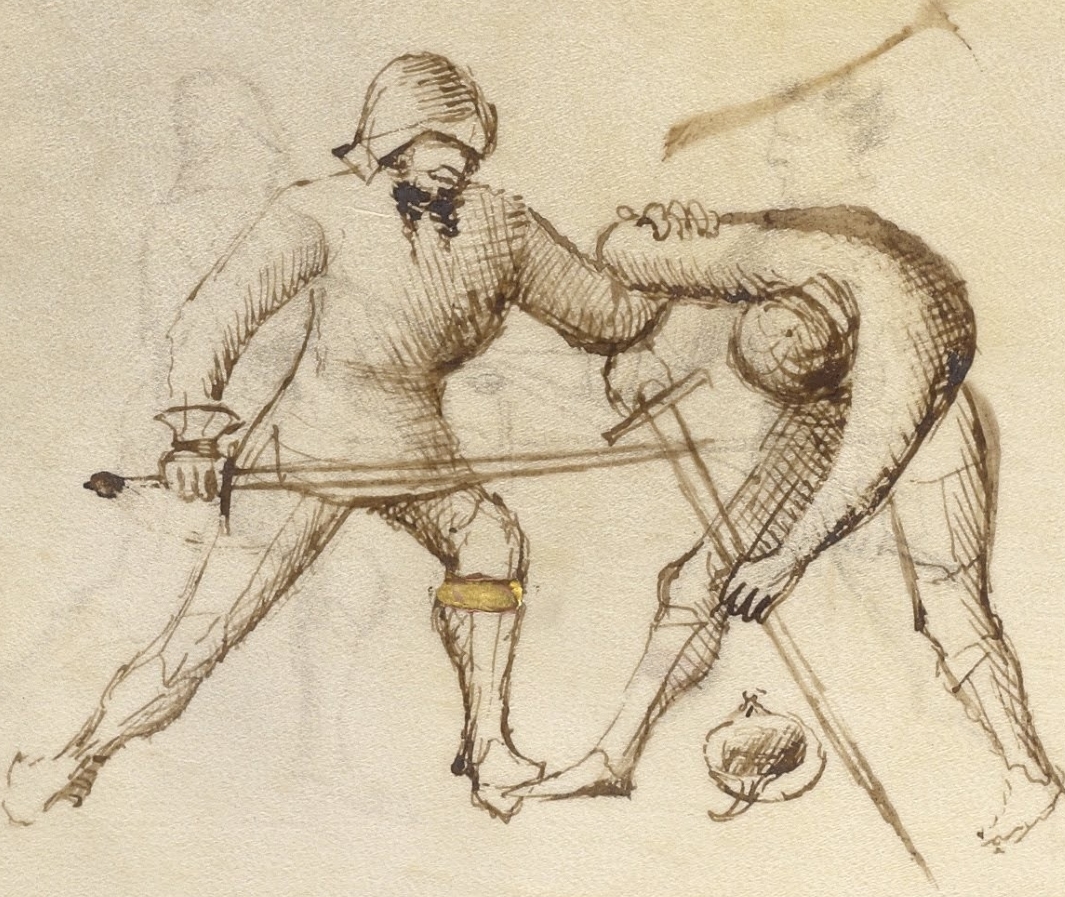
An example throw, from Fiore:


Here the Scholar (with the gold band on his leg) is depicted in the middle of throwing the student to the ground. The upper arm has disrupted the student's balance by shooting through his centre, and as the student begins to lose his balance, the Scholar "helps" the process along, directing the head down with his upper arm and propelling the student to the ground by grabbing and lifting the leg.

Locks
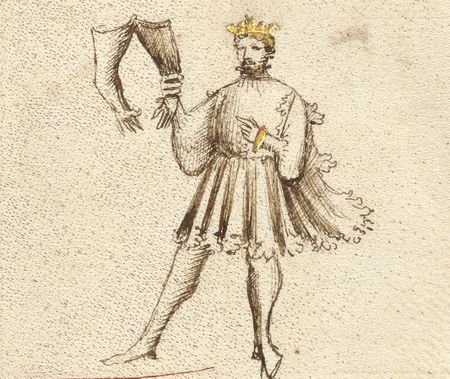
Because I triumph over those who fight with me,
I carry torn-off broken arms as a decoration.
[And I do not lie when I tell you that I have broken and dislocated many arms in my life.]
- Master Fiore Dei Liberi
Locking the arms of all opponents
In such a way that none can safely extend their right hand,
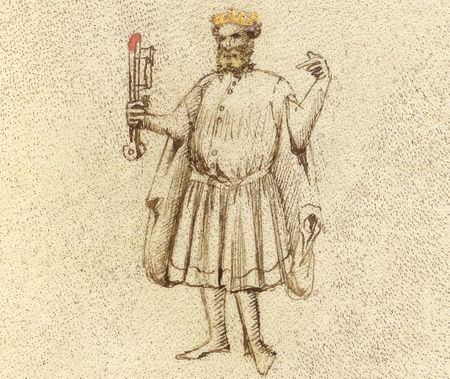
To show my success I carry a pair of keys in my hand.
- Master Fiore Dei Liberi
The body is organized in a certain way. Limbs bend in this direction, but not that. If you bend them forcibly in that direction, they are remarkably fragile. It's possible to cause immense pain and massive damage forcing limbs the wrong way.

There are a couple basic kinds of locks - keys and bars. For an example of a key, extend your arm straight out to the side, then - bending only at the elbow - point straight up. Now, try to rotate your arm at the shoulder to point backwards - you almost immediately hit the end of your range of motion.

If someone were to force your arm back like that, it would be immensely painful. They could apply a great deal of force, likely damaging your arm and almost certainly driving you forcefully to the ground.

The classic bar is the arm bar - this is basically forcing the elbow joint backwards by grasping the hand of an outstretched arm and applying force just above the elbow. Very little force is required to do massive damage to the elbow joint.

The Scholar executing an arm bar. Here, the hand of the outstretched arm is held in place by the Scholar's head (every part of the body is dangerous!) and the Scholar's arm is applying force behind the elbow. From here, the elbow can be stressed to breaking, or (more likely), the Student will bend to relieve the stress, and the Scholar could propel the Student's head into the ground.
The point with locks is applying force in a way that the victim cannot resist, either because (like an armbar) it's a 2-on-1 situation (two arms vs. one) or because the body has few muscles that can operate in that axis (like the key I described). Or both.

Various empty-hand defenses against weapons result in locks, for instance a two-handed defense against a vertical dagger strike can transition into the key I described, or an off-hand defense against a dagger attack from the high left side can be blocked and transitioned into an armbar.

Disarms
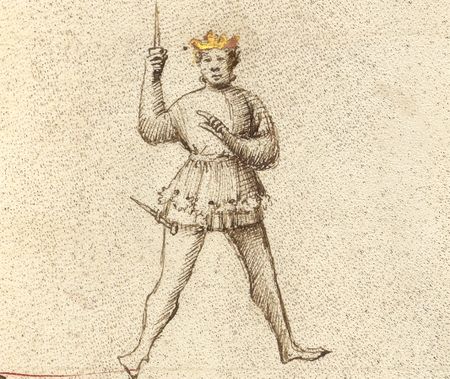
In my right hand I hold your dagger, and I gained it through my skill, which is so good that if you draw a dagger on me, I will take it from your hand. -Master Fiore Dei Liberi
While a popular TV/Movie trope is the "trick" sword move that disarms the enemy, this is highly unlikely. In order to take a weapon away, you have to get your hands involved.

This can arise from an empty-hand defense against an attack, or as a natural result of weapon play.

For instance, if an attack ends with the opponent's pommel in reach, it may be possible to grasp the pommel and twist it against the opponent's thumb, forcing the sword out of their hand while your sword ensures that they cannot land a hit while you're doing that.

An ideal empty-hand dagger defense ends with a disarm - one example would be stopping a blow coming from high on your left side and redirecting their energy past you and twisting their arm down and to your right. Executed properly, your forearm will press against the flat of their dagger and force it out of their hand.

Strikes

I can't find the exact passage at the moment, but Fiore reminds us that we should never forget striking with the empty hand - i.e. punches, kicks, knees, headbutts.

The ideal targets are the soft spots - the solar plexus, the neck, the nose, the groin, or places where great damage can be done - the knee, for example, can be devastated by a kick.

"Dirty" Techniques

Fiore was writing a book of war for people who would be engaged in lethal combat. As such, no effective technique is omitted or disallowed.

Someone choking you? Gouge their eyes.

Someone grappling close? Knee them in the groin (by all accounts, this is very effective regardless of their sex, despite what some may think).

Fish-hooks (digging a finger in between the teeth and the cheek) can be very effective at moving the opponent around, using the principle "where the head goes, the body follows".

Against a bear-hug from behind, grab a finger and twist it backwards until it breaks.

Someone's hand near your face? Bite their finger off.

Someone's face near your face? Bite their nose or ear off.

In a fight where you expect death is on the line, no technique can be rejected as "dirty" or "unsportsmanlike".

Integration with Weapons

I alluded to this in the section on disarms, and several times before, but the empty hand is always available, even when you're holding a weapon. It's totally possible for a winning move in a fight to be dropping your sword and attacking a vulnerable arm with a lock, or dropping your pinned poleaxe and moving in aggressively for a throw.

Summing Up

The human body is a very potent weapon with the right skill and training. I definitely know people that in a hypothetical fight to the death, I would not bet on me even if I had a sword and they did not, such is their skill at unarmed combat.

I also can't overstate how disorienting, painful, devastating some of these techniques are even in a friendly environment.

The empty hand - the first and last weapon of humanity. Don't underestimate it.

28 December 2013

Real-world Weapons: The Stick

Even more venerable than the spear, the stick is almost certainly the first weapon used by humanity. Only the stone is possibly older.

But, much like the spear, the stick suffers nothing in usefulness for its advanced age.

Master George Silver, writing ~1600, was of the opinion that the stick (the quarterstaff, in his case, a monstrous 8' ash shaft) was the "best weapon against all manner of weapons".

Description

The form of the stick varies perhaps the most amongst weapons. In its simplest form, it is simply a section of tree branch, perhaps two feet in length.

At its most advanced, we have the English quarterstaff (also known as the short staff), 6-8' in length, with steel or iron caps on the ends.

Other variations are the long staff, 12' in length; the walking stick (an exemplar being the Irish shillelagh), 2-3' in length with a weighted handle; and shorter staffs such as the 4' stick used in Jogo do Pau.

So, there is a great deal of variation in the stick - probably more than any other weapon.

Luckily for us, each type of stick weapon is similar to another weapon we've already discussed. The quarter staff is very similar to the spear. The shillelagh is similar to a mace. Short staffs are like inferior swords. The long staff is like the pike (which I have not discussed, as it is only relevant to formation combat). So, we can simply treat the differences between each type of stick and its closest relative.

Offense

The Quarterstaff

The quarterstaff is superficially similar to the spear, and there are similarities in their fighting techniques. However, the quarterstaff is typically somewhat longer than the spear, and it is typically gripper near the back end (as opposed to the more typical "half-staff" grip used on the spear, similar to the "half-sword" grip on the longsword).

The primary attack of the staff is the thrust, and for those doubting the power of a thrust from a staff, imagine a punch with more than double the power behind it being concentrated down to a steel or hardwood disk half the size of a fist. It's clear that a blow from a staff can be easily four or more times harder than a punch - easily enough to KO someone, collapse their windpipe, stun them, or rob them of their balance.

The staff can also strike, whipping the end quickly to hit the head, using the hips to generate power. The longer the staff, the more powerful the strike (but also the more power needed to generate the strike). The staff can perform all of the strikes the swords can - downwards, upwards (useful for groin shots), and side-to-side.

George Silver recommends using a combination, especially against a swordsman, as he finds that a swordsman has trouble defending against a thrust followed quickly by a strike (or vice versa).

The Shillelagh

A shillelagh is basically a big mace.

The Shorter Sticks

The main thing to remember when dealing with short sticks (2-4') is that, while they may be used much like swords, their capability for wounding is much less, and more attention needs to be paid to the continuation of the fight after a blow, as one blow will almost certainly never end the fight.

Defence
  
Silver is a big fan of the quarterstaff, and he is of the opinion that a man with a staff could best two equal opponents armed with swords, due to the massive reach advantage.

As with all weapons, an important part of staff fighting is grappling, perhaps even more so with stick weapons, as they lack the sharp parts that discourage the opponent from grabbing the end of the weapon. If the opponent grabs your staff and you can't get it back, you need to be immediately prepared to close to the grapple or flee. Or draw another weapon, although now your opponent has your staff, which is likely to be superior to anything else you are carrying!

3 December 2013

Real-world Weapons: The Poleaxe

The poleaxe (aka pollaxe, polax, poll-axe, pole-axe, pole-hammer, two-handed warhammer) was one of the most popular weapons of the high middle ages. Combining the virtues of the warhammer, axe, and short spear, it was a versatile weapon designed primarily for defeating plate armour.

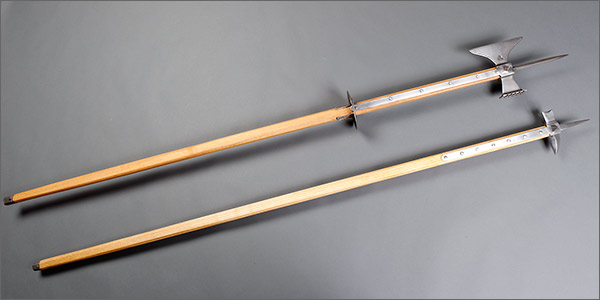
A hammer/axe poleaxe and a hammer/backspike poleaxe.
Description

The classic poleaxe, to my mind, is a six-foot square hardwood shaft with a hammerhead, backspike, topspike, buttspike, and sidespikes.

There are a few variations on the poleaxe, all of which revolve around the head. All will have some variation of axehead, hammerhead, and backspike. It could be axehead/hammerhead, hammerhead/backspike, or axehead/backspike. All have a long heavy-duty spike on the top, and a short spike on the bottom. Most will have a short, round hand-guard a foot or two below the head, and most will have short spikes on either side of the head.

One of the main differentiating features between the poleaxe and the very similar halberd are the langets on the sides (the metal strips running down from the head in the pictures above). A halberd head is typically forged out of a single piece, and attacked to the shaft like a spearhead via a tube and pin. The langets made the end of the weapon significantly stronger and more durable. They were part of the modular forged design of the poleaxe - each piece of the head was forged separately, which allowed a stronger construction than a single piece stretched and flattened out.

A poleaxe with an axehead would also have a smaller blade than a halberd, the better to defeat armour.

Similar Weapons

The halberd, lucerne hammer, and bec de corbin are all pretty much the same weapon as the poleaxe. The differences are basically just in head design - halberds always have axeheads and backspikes, lucerne hammers and bec de corbins always have hammerheads and backspikes.

For game purposes, I believe it's totally reasonable to treat all of the "complex" poleweapons as poleaxes - glaives, voulges, bills, partisans - all of those wacky stick/blade combos Gygax loved so much. Yes, they're all different, and all have different fighting styles, but there are distinct similarities that set them apart as a category.

Offence

The complex polearms, as exemplified by the poleaxe, are generally good for both utterly devastating two-handed swings and powerful thrusts. For an idea of the force involved, imagine smashing a melon with a baseball bat. Now imagine the baseball bat is twice as long and has a metal hammer head on the end.

The poleaxe can easily pulp the skull of an unarmoured man, the axehead can sever limbs, and the topspike can easily force its way between the links of chain mail. The topspike even has a chance of piercing through a breastplate.

The guards and actions of the poleaxe are something of a hybrid between the longsword and the spear. Its use is also something of a hybrid of the two, the main difference from the longsword being the extended reach and the ability to trap the opponent's weapon with the complex head. The main difference with the spear is the equal focus on striking and thrusting.

This guard is shared by the longsword, poleaxe, and major league baseball. Fiore calls it the "Guard of the Woman" (Posta di Donna). Much like a baseball player, the master is prepared to swing the axe around with a hip rotation, imparting devastating speed and power to the axehead.


Defence

As the poleaxe is typically used by a fully armoured man against another fully armoured man, grappling is integral to defense, as even with a poleaxe it's not always easy to down a man in full plate harness. It's not uncommon for two combatants with poleaxes to get their axeheads tangled on the ground and abandon their poleaxes and switch to their daggers or to attempting a throw.


A combination axe/grappling play. The scholar (on the left) has obtained a key (a type of arm hold) on his opponent, immobilizing him for a counterstrike.


Otherwise, much like with offense, poleaxe defenses can be similar to spear or longsword plays, either seeking to knock the opponent's weapon offline and thrust, or to beat aside and land a strike.


30 November 2013

Real-world Weapons: The Spear

The spear is, without a doubt, the most popular weapon of all time. From the dawn of time until WWII, the spear was issued in vast numbers to the common soldier. Surprised to hear that WWII soldiers were issued spears? Well, a rifle with a bayonet on it is functionally a short spear. Bayonet techniques owe a heck of a lot to medieval spear techniques, which, I'm sure, owed a lot in their turn to Stone Age spear techniques.

The reason for this is simple, and two-fold: the spear is cheap and easy to make, and it is extremely effective. I've said it before, and I'll say it again: it's not for nothing that the spear is the King of Weapons.

Description

I'm not sure this is really necessary, but...

The most basic spear is simply a sharpened stick, 5-8 feet long. At it's most advanced, the spear has a steel bladed head, 18" long, with lugs at the bottom of the head, a sharpened steel buttcap on the base, and a polished and lathed ash shaft 6-7 feet long.

The butt cap is an important point - many people don't realize that medieval spears have a sharpened steel spike covering the bottom. This makes the spear significantly more dangerous than if it only had the bladed head at the top.

A spearhead and buttcap.


The lugs allow some more parrying options, but they're certainly not necessary. Fiore's spear treatise doesn't show them except in the bit on a spearman vs. a horseman.

Spearhead with lugs.


Offence

Offence with the spear is really fairly simple - insert the point into the face of your opponent. Keep in mind, though, that the spear has a point on both ends. Since any defence against the spear will involve knocking the spearhead offline, a common tactic is to absorb and use the energy from that knock to spin the spear 180° and attack with the buttspike instead of the head.

Much of the stuff that applies to the halfsword (discussed in my earlier post on the longsword) also applies to the spear, as halfswording is really just turning your longsword into a 4-foot spear.

There is currently debate about whether the spearhead or spear shaft were used for striking as well as thrusting. There is little direct evidence for spears being used for striking, but arguments can be made for it. Viking sagas speak of "hewing spears" which were used for cutting. What these are is unknown - it is possibly just a normal spear, a spear with a long head, or something more like a glaive or naginata (i.e. a sword on a stick, as opposed to a spear, which is more like a dagger on a stick).

From handling spears, I can safely say that being bashed with the end would be pretty awful. I have little doubt that a solid hit from a spear could break bones in an unarmoured target.

There's also the fact that in Fiore's medieval fighting system there's a certain universality to the techniques - since the sword can be used like a spear, it's not unreasonable to see the spear sharing some techniques with the sword.

Wiser people than me disagree the the spear is used for bashing, though, so take the notion of bashing with the spear with a grain of salt.


Defense

Striking sideways with the spear definitely comes into play on the defensive. Most of Fiore's spear guards have the point off the line, pointing up, back, or to the side. The point-forward guards, while having the point forward, can still generate significant sideways force with a passing step.

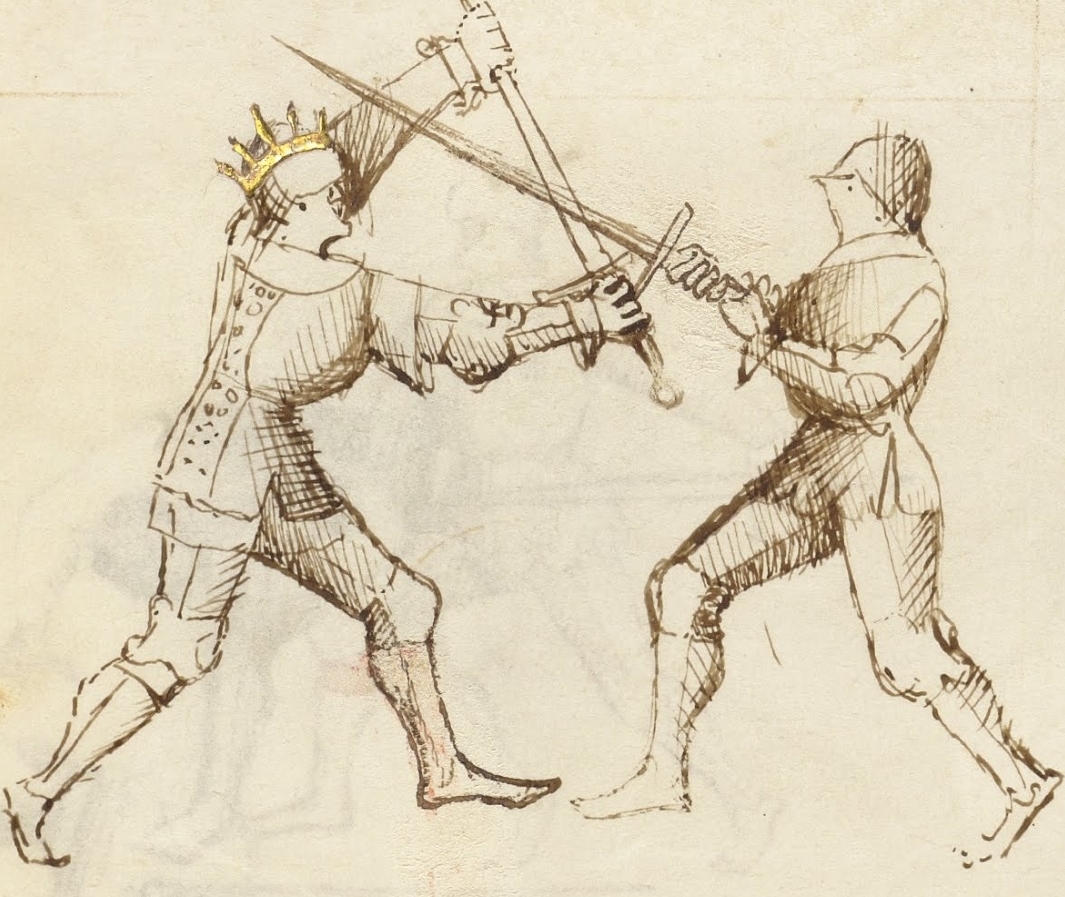
The master (in the crown) stands in a typical defensive guard. His point is facing away from his opponent so that he can swing it around forcefully to knock his opponent's spear aside. Note that the combatants are depicted much closer than they would really be standing in combat!


The basic defence with the spear is to turn and swing your spear to strike the opponents weapon aside, ending up in a position where your point is directed at the opponents face or neck and your spear is between you and the opponent's weapon. If you over-parry (i.e. your spear keeps swinging past their face), you can keep that energy going and turn the spear right around and strike their face with the butt spike.

The master has successfully parried from the previous position. The momentum of the opponent's attack has carried him right onto the master's spear.


24 August 2013

Real-world Weapons: The Longsword

In many ways, the longsword is very similar to the arming sword. It's a little longer, and a little heavier, but it actually performs rather differently.

Description

Your basic longsword is about 4 feet long and about 3 lbs in weight. Longswords are built either for unarmoured or armoured combat, or built to make a compromise between the two.

Longswords built for armoured combat have a stiff blade, aggressively pointed. This is to facilitate the powerful thrusts required to defeat armour. The last few inches will be very sharp. Designs differ, but there will often be some provision for grasping the blade with your off-hand (this is known as "half-swording") - either the whole blade will be sharp save for a hand-sized portion in the middle of the last third, or only the tip will be sharp. Some longswords designed for armoured combat will have the quillons sharpened to points, to allow devastating quillon punches and mortschlags (more on that later).

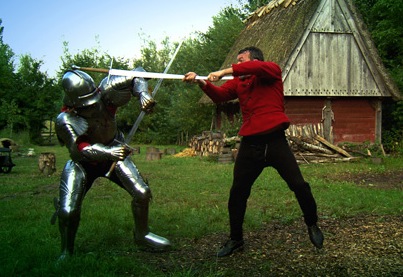
An armoured man holding his sword in "half-sword".


Longswords built for unarmoured combat will have a more flexible blade, sharp all the way down. It may not be quite as aggressively pointed.

I'd like to clarify that the "unsharpened" portions are not totally dull, they're just not nearly as sharp as the rest of the sword.

Misconceptions

The longsword, despite being a weapon of status, was not typically the primary battlefield weapon of armoured men, who typically preferred spears or poleaxes. The longsword was primarily a sidearm or a self-defence weapon.

Much like the arming sword, the cuts are delivered by pushing the balance point forward not with big swinging arm movements - . The big difference with a two-handed sword is that you do a "lever" action with your two hands, moving your right hand forward and your left hand back to snap the tip forward faster and more powerfully.

Offence

While half-swording (illustrated above) is possible with an arming sword, the extra 8" of blade (the other 4" of increased length over an arming sword is in the handle) really does make half-swording a longsword more viable.

Half-swording basically turns your sword into a small spear, and many of the spear plays are possible with the half-sword. It provides a powerful defence that can easily transition into a powerful thrust, and because it gets you in close, it puts you in a great position to enter and get into grappling.

Both Fiore and Vadi say, "the sword is an axe". While this statement is rather cryptic alone, by looking to the German tradition, we see a technique called the "mortschlag", or "murder-blow".

From historicalfencing.com - a mortschlag delivered to the vulnerable back of the shoulder.

The mortschlag involves grasping the blade with both hands, and swinging the sword exactly like an axe or mace. Ringeck advises that mortschlags be delivered to the foot, the hand or arm, or to the back of the hip or shoulder. Tallhoffer (I think - I know some of my readers are better versed in the German tradition than I am, and will surely correct me) describes used the crossguard to hook and disarm from  mortschlag.

The other side of the comment "the sword is an axe" is, in my opinion, that the sword and the axe share, amongst the knightly weapons, that is equally capable of thrusts and blows.

The other thing worth mentioning is that the sword can be used as an extra lever in holds, locks, or disarms. The point of the half-sword can be slipped between the arm and the sword and twisted for a disarm. If you can get behind your opponent, the sword can be held against their throat with a hand on the blade and one on the handle for a choke-out, severe neck wound, or a throw. When applying certain keys, the sword can be used to help lock up the arm and provide additional leverage for a break or throw.


Defence

In defence the longsword is used much like arming sword except at the half-sword, so that's what I'll discuss here.

Much like the spear, the half-sword can be used to knock a blow or thrust aside and immediately counter with a thrust of your own, or blow right through into a pommel/quillon strike.

From this block, you can turn your sword to the right, simultaneously displacing your opponents sword and directing your point at his face or neck, or come to a grapple as we see below.

Once you've blocked or parried at the half-sword, you're going to be very close to your opponent, and many defences in armour revolve around grappling. A man in armour is extremely well-protected, and throwing him to the ground is a great way to neutralize that advantage. Working at the half-sword facilitates this.

Coming to an arm lock - the opponent can be forced to the ground from here. If they strongly resist the throw, their arm will break.


From here, you can throw your opponent to the ground by pushing back on his head with the tip of your sword. Obviously, if he doesn't have good neck protection, he'll be severely injured even before he hits the ground.


A possible follow-on from the first half-sword defense I showed - push forward and slip the sword behind the neck, then use that powerful grip to hurl the opponent face-first into the ground.


31 July 2013

Real-world Weapons: The Arming Sword

Description

The "Arming Sword" is what I think most people think of (incorrectly) as a "longsword" or a "broadsword". The arming sword is the classic "knightly" sword of the High Middle Ages - a one-handed, cruciform, double-edged cut-and-thrust weapon with wide quillons and a heavy pommel.

Typically would be about 3' long, and about 2-2.5 lbs. Balance point is a few inches along the blade from the guard.

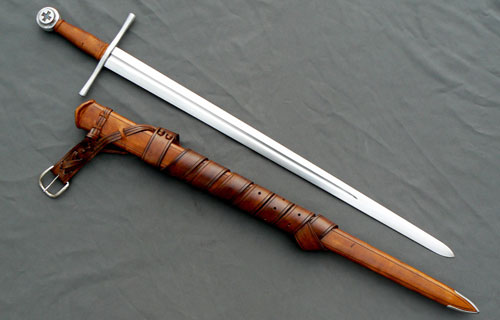
A typical arming sword with scabbard, displaying the main features of a typical arming sword - tapered double-edged blade, straight quillons, heavy metal pommel. This sword is a replica of a typical Crusades-Era sword from Valiant Armoury, but arming swords around 1400 were substantially the same. Link to the Valiant Armoury page: http://www.valiant-armoury.com/catalog/txt_CF408.html
Misconceptions

Some of these have been dispelled before, but it bears repeating. One of the main myths around swords is that they were heavy - this is not so. An arming sword would weigh a little over 2lbs - no more than 2.5lbs.

They were not the dull, heavy, metal clubs some people seem to think they were - the arming sword is nimble and sharp.  Now, the sword wouldn't be sharp like a razor blade is sharp - more like a chisel, but still sharp enough to easily cut an arm or leg off, decapitate someone - even cut them right in half. I'll have some caveats to this in my longsword article.

This is more of a general combat misconception, but sword combat doesn't take place at punching distance - two people aren't going to stand 4 feet apart bashing away at each other. Much of the fight will be at more like 10 feet, with a lot of fluid forward and back movement as the fight progresses.

A misconception I saw in a comment on another one of my posts was that you could wait for a sword swing to "go by", then rush in. This is not possible, as sword swings do not "go by". The finishing position of a sword strike that doesn't connect is with the point out in front of you, directed at your opponents neck or head.

Even if the sword did "go by", the nimbleness of a sword means that your rush would simply end with you having an arm cut off or being impaled.

Offence

The European cruciform sword is one of the most versatile weapons out there. It has cutting edges on both sides, and is straight and pointed for powerful thrusts. The quillons and pommel can be used to punch and strike - some swords even have sharpened quillons for more powerful quillon punches. In a pinch, it can even be used two-handed with one hand on the pommel, although it won't have the power of a true two-handed weapon, due to the limited leverage the off-hand will have.

The arming sword can be used with a shield or buckler (as detailed in MS I.33, the earliest known European martial arts manual) or alone (perhaps more common in a self-defense situation, described in Fiore's works).

I.33 does a good job of illustrating the way you fight with sword and buckler - keeping the two together, moving them as one weapon, using the buckler to cover your sword arm as you attack. You still are mainly using your sword to defend yourself - the buckler is there to help. I'll write more about shield combat when I get to shields. Suffice to say at this point that 1 point to Defense is undervaluing shields significantly.

Using the sword by itself opens the possibility of grappling with your off-hand - after you or your opponent make a successful cover, you may have an opportunity to grab the pommel of their sword, lock up their arm in a key or a bind, or even get really close and throw them to the ground.

Successful attacks with the sword are seeking to place a thrust in the head or neck, or less optimally in the chest (as the ribs are much harder to get through). With cuts, you can strike a near-vertical stroke down, looking to hit the head, or the base of the neck. Horizontal strokes can be aimed at the head, neck, or arms (preferably the sword arm, as chopping that off will instantly win the fight).

Rising strikes are typically aimed at the hand or arm, as their reach and power is less (and it doesn't take much force to lop off a finger), but they can easily be turned into a thrust at the end.

Defence

Defences with the sword are ideally seeking to displace the opponent's blade and make a strike or thrust at the same time. In the broadest sense, same counters same. A downward blow from the right shoulder will deflect a downward blow from the right shoulder. A thrust to the face counters a thrust to the face. If this was all there is to it, swordfighting would be a piece of cake - obviously, there are many other options.

Fiore describes a "universal defence" using the sword in one hand - stand with your right side to the enemy, sword down and back pointing past your left foot. Against any sword attack, you can step offline and cut into the attack, deflecting it and positioning yourself in a great place for a counterstroke. Interestingly enough, the starting position for this is basically leaning away from your opponent with your sword in its scabbard.

If a defence ends up with the swords bound (i.e. stopped edge-to-edge), you have a number of options - wind your sword around theirs and strike, grab their hand or arm with your off-hand to control their sword and strike, disarm them, slam them in the face with your pommel or quillon, a kick in the knee or groin...


30 June 2013

Real-World Weapons: The Axe and Mace

Difficulties

I must admit, I am significantly less familiar with the short unbalanced weapons than I am with, say, the sword and spear. Additionally, there are no period texts detailing the use of the mace or the short axe. Dagger, sword, spear, poleaxe, yes - axe and mace, no. So much of what we can say about these weapons is speculative.

What we can do is look at surviving specimens and accurate reproductions to get a sense of what the weapons were like, physically.

Descriptions

A standard European mace. This is likely a little out-of-period for me, likely c. 1450-1500, but is substantially similar to earlier models. Image courtesy of Nazanian and Wikimedia Commons.
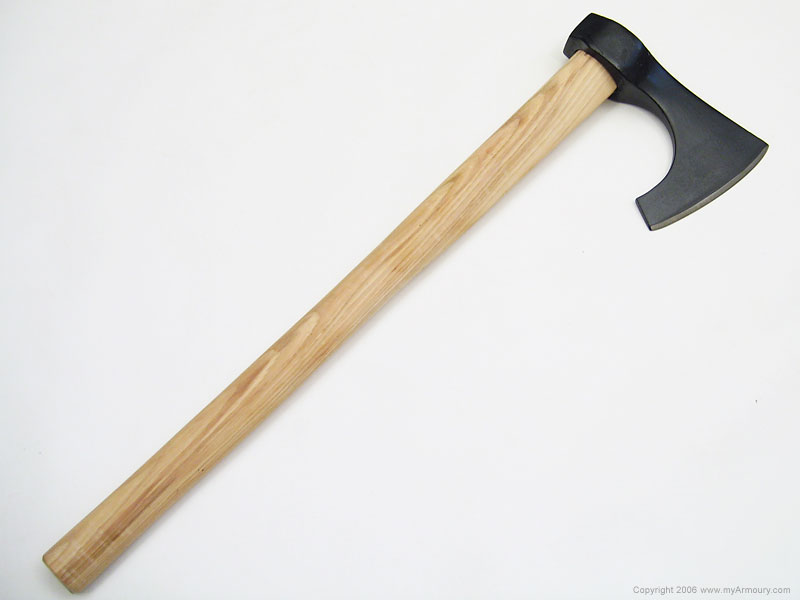
Replica battleaxe, based on an archeological find in Norway. Reasonably typical of battleaxes in general. Photo from myArmoury.com, axe by Arms & Armour.

First off, these weapons are shorter than I had previously thought - one handed maces don't seem to vary much from the 24" mark. They're also lighter than I had thought - rarely more than 3 lbs, and often only 2 lbs - sometimes less. The same goes for axes, although they tend to be a little smaller and lighter still!

The balance point ranges from the middle of the weapon to a little past the middle (i.e. closer to the head). It looks like the balance point would be further, but there you are.

This all contributes to making maces and axes significantly handier in combat than you might expect.

Mace - Description

The difference between a mace and a club is subtle. To my mind, the defining features of the mace are two-fold: all-metal construction, and the use of flanges or knobs on the head.

Length: 20-30"
Weight: 2lb
Balance point: 2/3 up from butt end.

Mace Variation - Morning Star

The morning star is simply a mace with spikes instead of knobs or flanges, especially if there is one larger spike at the very top for thrusting.

Axe Description

Military axes had very small, thin, light heads compared to woodcutting axes or hatchets. The head would also often have a cut-out between the blade and haft, allowing for the axe to be used for hooking, and reducing weight while maximizing cutting area.

Length:18"-30"
Weight: 1-2lb

Axe Variation - Military Pick / Warhammer

A military pick or warhammer are basically just piercing or bludgeoning versions of the axe. Some axes even incorporate a pick on their back end, and most warhammers have a hammer side and a pick side. Otherwise, they are very similar to an axe. 

Misconceptions

It seems to be a common misconception that maces and axes were big, heavy things that dealt damage through their weight and brute force. The reality is that they were usually smaller and lighter than swords, and relied as much on the speed of the swing as on their unbalanced weight distribution.

Offence

Archaeological evidence shows that people killed by axe blows were typically struck from above, leading me to believe that fendente (i.e. overhead strikes) were more typically used with these weapons than mezzane (strikes parallel with the ground). Logically, this makes sense - gravity would be pulling the heavy head of the weapon down, lending more force to the blow for free.

The other common injury with axes seen is leg injuries. This is likely because axes were used with shields - two fighters with shields apparently find opportunities to hook the axe under the opponent's shield. Later treatises of the sword don't describe leg strikes - they focus on attacks to the head, neck, and weapon arm.

Defence

A dagger play that might be usable with an axe. From the Pissani-Dossi MS of Fiore Dei Liberi's manual.


Two more dagger plays that might work with an axe or mace. From the Paris Manuscript by Fiore Dei Liberi.


If using an axe or mace with your other hand empty, you could possibly do some dagger/baton defences with the shaft. The problem immediately apparent in adapting these plays is that axes - while they can thrust - are not suited for the devastating thrusts to the vitals that daggers are capable of.

It may be possible to do some of the sword defences, but the short shaft and lack of guard would limit your options there. While handier than you'd think, an axe or mace is not going to be a great option for your only defensive weapon.

Except in urgent situations, typically an axe or mace would be used with a shield. This makes up for the lack of agility compared with a sword - at least compared to a sword without a shield.

28 June 2013

Weapon Types, or Why Exhaustive Weapons Charts Are Unnecessary

A comment by JDJarvis brought to mind that I've never talked about why I use the weapons I use on my charts and examples. There are two main reasons.

Firstly, I'm most interested in the 14th century and early 15th century. Call it 1325-1425. The weapons I list are the most common weapons of that era - the dagger, the arming sword, the longsword, the mace, the axe, the spear, and the poleaxe.

Secondly, I intended this list to be broadly applicable, despite its brevity. I believe the user of the system should be able to easily extrapolate new weapons, as with these few weapons, I've covered all the archetypes of melee weapons:
  • small (dagger)
    • less than 18" or so in size
  • balanced one-handed (arming sword)
    • balance point within 4" of hand
    • nimble, defensive
  • unbalanced one-handed (mace, axe)
    • balance point around middle of weapon or further from grip
    • good against armour
    • less nimble, less defensive
  • balanced two-handed (longsword, spear)
    • balance point near the hands at one end OR
    • balance point near middle of weapon
    • strong offense and defense
  • unbalanced two-handed (poleaxe)
    • balance point closer to "head" of weapon
    • good against armour
    • strong offense and defense
As far as I know, all melee weapons can be slotted into one of these categories. JDJarvis asked about shortswords (presumably of the Roman variety), warhammers, and cutlasses.

I would put the Roman shortsword into the "small" category (some might argue for it being in the "balanced one-handed" category, but that category implies more defensiveness than a shortsword provides), the warhammer clearly is unbalanced one-handed, and the cutlass clearly balanced one-handed.

Halberd? Unbalanced two-handed. Tomahawk? Unbalanced one-handed. Club? Unbalanced one-handed. Rapier? Balanced one-handed. Scimitar? Balanced one-handed. Falchion? Balanced one-handed.

When I see the weapons lists in many RPGs, lists that often take up whole pages, I shake my head. Do we really need to mechanically differentiate between a cutlass, a scimitar, a falchion, and an arming sword? Aren't they all pretty much bladed weapons, about 3' long, with a balance point about 4" from the grip? Isn't just one example sufficient? I feel the huge charts of weapons clutter up the book, and confuse new players.

Perhaps a compromise in a finished product would be to list the few weapons I have, briefly explain the rationale behind the categories, and provide a simple (but fairly exhaustive) list in an appendix of how all other medieval(ish) weapons fit into the system.

26 June 2013

Real-World Weapons - The Dagger

I'm starting a new series on Real-World Weapons - i.e. the weapons we know and love from D&D in a real-world context. I hope that this series will illuminate the use of these weapons to the reader, enabling players to employ more varied, effective, and realistic tactics in battle, and helping DMs deliver vivid fight scenes that have the ring of truth to them. 

I'm starting this series off with a weapon that doesn't get a lot of love (outside of Magic User circles) - the dagger. I'll be continuing on with the short, unbalanced weapons (axes and maces), then the swords (arming and long), and eventually the polearms (spear and poleaxe). I may do more later on, but most other weapons are pretty similar to one of these - enough that they can probably be treated the same mechanically.

Description

The medieval dagger of the period was about the size of a really big carving knife - the blade would be about 12"-18" long, with an extremely stiff blade. It's primary purpose was piercing, but it would typically have at least one sharp or semi-sharp edge.

Rondel Dagger c. 1350 found in the Thames River, London - image from Wikimedia Commons, courtesy of Dana Williams


Offense

Daggers typically deal low damage in RPGs, to distinguish them from the bigger weapons. I would posit that the 0e system of d6 across the board is not that far off. All Medieval weapons were more than capable of killing a normal, unarmoured man outright in a single blow, and this is how Oe works.

The 12" blade of a dagger can do some really serious damage to the human body. A blow to the head will pierce the brain, likely instantly killing the victim. Neck shots will sever arteries, cut the windpipe, or damage the spinal cord. Blows to the trunk are typically less useful, as the ribcage is pretty tough, but a blow that comes down through the collarbone or between two ribs could easily puncture a lung. Stabs to the abdomen can pierce the liver, kidneys, or other vital organs, leading to rapid death from internal bleeding.

That said, many of the blows from a dagger would be to the hands and arms, where they would be painful and dangerous in the long run (i.e. slow bleeding and infections), they likely wouldn't put you out of the fight. Glancing blows will slice the victim up, but again, likely not enough to put the person out of the fight.

This is my justification for giving the dagger 2d6-TL (2d6 Take Lowest) - enough that it can be very dangerous, but blows from it typically will not kill you.

Usage Vs. Armour

The Medieval dagger was also a valid tool against an armoured opponent. Its stiff blade and sharp point made it ideal for forcing through chain mail, and it can still be used in a grapple once other weapons have been abandoned.

In a close fight between armoured opponents with daggers, each will be seeking a weak point to drive it in, and there are a few choice targets. Depending on the helmet, there may be some great targets on the head.

If the helm is unvisored, like the popular kettlehelm or early bascinets, the face has only thin bone between blade and brain, and is an excellent target.

If the helm is visored, like the popular hounskull bascinet, it may be possible to open the visor and attack the face.

Lastly, if the helm is one solid piece, like a greathelm, the eyeslits can be a target. This is probably most practical if the victim is pinned on the ground, limiting their head mobility, as the eyeslit is a very small target, and they often had flanges to direct thrusts away from them.

After head strikes, the neck is another good target. In-period, the neck was often defended by a plate gorget (which would be more or less impermeable), with or without an aventail of mail around it. In a very close grapple, the attacker might be able to lift the back of the aventail, and get his dagger in the back of the neck, severing the spine or major arteries, or plunging the blade down in the hopes of hitting the heart or lung.

Barring any of those options, the armpits were typically only armoured with chain, which a dagger could be forced through.

Defense

Plays of sword and dagger, from the Getty MS Ludwig XV 13, by the Master Fiore Dei Liberi c. 1410.

While the dagger is rather small, it is not useless for defending yourself - anything that you can directly control an enemy weapon with is better than nothing!  In fact, you can make most of the dagger defenses with any kind of similarly-shaped object - a stick, for example.

I've rated the dagger's defensiveness as low, because it is so small it's easy to screw up your defense, and it can be overborne by powerful weapons like the poleaxe.

A defender with a dagger facing someone with a superior weapon would be trying to do a few things, typically.

Controlling the opponent's weapon is always the first priority, as killing them is little good to you if they kill you at the same time. The dagger doesn't offer the leverage of a sword, or the reach to strike from the bind (i.e. weapons crossed). Therefore the person with the dagger will likely try to transfer control of the opponent's weapon from the dagger to their offhand after parrying an attack.

From there, they can seek a lock (like a key or armbar), a disarm (most viable against a one-handed weapon), probably all combined with an attempt to maneuver in beside or behind the opponent for an opportunity for one of the lethal strikes I described above.

24 June 2013

Confined Spaces

Edit: updated Longsword length to be 4', a better estimate than 3.5'.

Previously, I'd talked about reach in the abstract, without considering the space you're in. How do we deal with the restrictions imposed on fighting by a confined space? I've touched on this issue here before, in my post Dungeoneering Tools: The Spear, but I'd like to develop something a bit more general, as the subject of confined spaces obviously affects more than just the spear.

Confined Spaces

What constitutes a confined space is going to vary based on what kind of weapon you're used. A space that is "confined" for a spear could be spacious for a dagger. There are also some weapons that have options for how to fight with them - something like a longsword can be held with one or two hands on the hilt, or with one hand on the hilt and one hand on the blade (called "halfsword"). A spear can be gripped in thirds (the usual way for single combat) or with one or two hands down at the butt (for formation combat).

See below for a detailed and simplified chart of how much space different weapons need to be used effectively.

Effects of Confined Spaces

If you don't have enough space (in any dimension) for using your weapon properly, you don't get any Defense or Attack bonus for your weapon. Also, any rolls above 10 on your d20 attack roll count as a 10.

If the space is too small to wield the weapon at all (e.g. trying to use a 7' spear in a 6'x6' closet), obviously you can't use it at all.


Weapon Reach

The reach of a weapon is equal to: the length of the weapon past the hand + the length of the arm + the length of one step + a little bit for body positioning. Anything within the reach of the weapon is a potential target.

Footwork

In addition to the length of the weapon, there's also the footwork required for using it effectively. This is fairly consistent across weapons, and can probably be generalized to about one step per round in any direction.

Weapon Usage Style

There's also the matter of usage style. Spear, longsword, and poleaxe immediately occur as having a couple of options for how to use them.

Spears, poleaxes, and longswords can be held in thirds (i.e. each hand 1/3 from the respective end) or at the butt (i.e. both hands down near the end). Holding a spear by the butt gives it great reach, but limits its offensive and defensive power. Holding a spear in thirds gives its attacks and parries great power, and opens up the possibility of using the spear as a lever when grappling (e.g. a missed thrust to the head turns into an attempt to knock the person down by hooking the spear around behind their head and pulling them down).

Poleaxes and longswords can be swung when held at the butt, which for poleaxes obviously needs a great deal of room.

Space Requirements

Most weapons are going to need a radius of their reach around them, and probably space above them (approximately weapon length + shoulder height) above them.

Let's categorize weapons:

Detailed table:


Weapon

Length (effective)

Max Reach
(length + arm + step + lean)

Min width
(length x 2 + step x 2 OR step x 2 for thrusting-only weapons)

Min Height (6' wielder)
(length+shoulder height)

Dagger

1

8

8

6

Axe/Mace

2

9

10

7

Arming Sword

3

10

12

8

Long Sword

4

11

14

9

Long Sword (halfsword)

4 (1)

8

8

7

Spear (thirds)

7 (3)

10

12-16

8-11

Spear (butt)

7 (5)

12

6

6

Poleaxe

6 (2-4)

9-11

14

9


And, an extremely simplified version, because that's a lot of fiddly numbers:


Weapon

Length (effective)

Max Reach

Min width

Min Height

Dagger

1

S

S

S

Axe/Mace

2

S

S

M

Arming Sword

3

M

M

M

Long Sword

4

M

M

M

Long Sword (halfsword)

4 (1)

S

S

S

Spear (thirds)

7 (3)

M

L

L

Spear (butt)

7 (5)

L

S

S

Poleaxe

6 (2-4)

M

L

L

For this table, S / M / L:
Reach: 8' / 10' / 12'
Width: 8' / 12' / 16'
Height: 6' / 8' / 10'


19 June 2013

Reach and the Nine and Thirty Kingdoms

Continued from the last two posts, and in response to this post.

Fighting Distances


Two people in a sword fight spend most of the fight about 10' apart - the distance of one step plus an outstretched arm with a sword in it. They only move in to make a blow.

Standing any closer than that is suicide, as you won't have time to parry an incoming blow (and will be forced to try to dodge, likely throwing yourself off balance and getting killed by the continuation of the attack). I talked yesterday about how important *not dodging* is.

Managing Distance


"But on the other hand, are we assuming that combatants are too stupid to try to get inside an opponent's reach? Too stupid to knock the spear aside with their shield? It balances out."

It would seem so, but it doesn't, and here's why.

For the person with the longer reach, it's easy to maintain a longer distance. Any time the opponent gets close, you circle away from them (i.e. step sideways and back). At no point is the long-reach person threatened in this series of actions - they are still too far away to be hit.

Additionally, at any point, the person with the reach advantage can simply step forward and attempt a blow in relative safety- they can strike while they are still out of reach of their opponent's weapon.

However, for the person with the shorter reach, in order to attempt a blow, they have to achieve a tactical advantage which will let them simultaneously catch the other person off balance enough that they can't circle away, control the longer weapon as they close (so they don't die), *and only then* can they attempt a blow. Much, much more difficult.

It's certainly not impossible, but hopefully that illustrates why it doesn't "balance out".

This is also a good argument for buffing spears back up to their full length, by the way.

18 June 2013

Shields, Axes, and the Nine and Thirty Kingdoms

Continued from yesterday's post, and in response to this post.

Shields - Not For Blocking


"Also, you'd certainly be better off focusing on dodging an ax than trying to block it with a shield that's going to be hacked to bits."

This seems to be based on a misconception of what a shield is used for. Yes, in a shield wall, you use a shield for blocking.

But in a one-on-one fight, the shield is used to defend you in the same way a weapon is used - by controlling and guiding the opponent's weapon, not by simply "blocking" it. If you're holding your shield out and taking the full brunt of an axe blow with it, you're doing it wrong.

Dodging - A Good Way To Get Yourself Killed


"focusing on dodging"

Dodging is a very small part of combat, and is really more of a last-ditch defense or a way of sweetening a parry than something to be relied on. You always want to be seeking to control the other person's weapon, and you can't do that by dodging. You need to be making contact - either with your weapon or your shield, or by grabbing their hand/arm.

There's a rule of fighting - "Never be uncrossed in distance." That means don't *ever* let your opponent so close they could hit you with just a hand motion, unless you have control of their weapon.

Hollywood depictions of combat are terrible for this - the two fighters stand sword toe-to-toe and slug it out, constantly crossing and uncrossing their swords while they're close enough to punch each other. Well, in real life, both of them would end up dead doing that - being uncrossed in distance tends to lead to double kills.

Furthermore, "dodging" implies (to me, anyway) contorting your body in some way to get out of the way, something you should ideally not be doing, as it breaks your structure and makes you vulnerable. It's far better to use your weapon for defense than to rely on dodging.

But this is getting into the territory I'm going to cover tomorrow, which is Reach, and why more of it is better.

Mechanical Problems


"That's a minor in-game justification, but since the goal is something minimalist that's in between the traditional Weapon vs. AC system and "all weapons are the same", it seems reasonable."

I respect the goal, but I think that any mechanic that encourages players to have their characters behave irrationally is broken.

You would most certainly be better off facing someone with an axe with a sword and shield than with just a sword. I think that really should be obvious.

I can see, if you want to give axes something special, maybe you could have them just negate the shield bonus (i.e. +1 vs. shield). There's no real-world justification for that, but it fits with the system you're building, and doesn't encourage bizarre character behaviour (i.e. "The orc has an axe? I quickly drop my shield and charge!).

A better approach might be something like, "unbalanced weapons count for twice their length", where unbalanced means any weapon with most of the weight at the end - mostly the mace and axe.

This would serve to model unbalanced weapons main function - dealing with armour.


17 June 2013

Spears, Weapon Mechanics, and the Nine and Thirty Kingdoms

In response to this post.

Talysman very kindly wrote a lengthy and detailed reply to my comments on his search for a middle-ground between a cumbersome weapon vs. armour table and no weapon differentiation. I was going to comment on his response, but I got a little carried away, so I'm putting it here. Quotations are from Talysman, unless otherwise noted.

The Goal

 As he so often does, Talysman perfectly encapsulates one of the central problems of designing a combat system (and I quote):
  1. Weapons seem different,
  2. Each is good at different times,
  3. There are hardly any rules specifically implementing 1 and 2, and
  4. They're easy to remember.
That's sort of the holy grail, and a particular bugaboo of mine, so I'm always delighted to see other people chipping away at this problem. Now, the spear became sort of a central issue to the discussion, and I think it merits discussing the spear a little more in depth.

The Problems


Now, there's a few problems I see with Talysman's approach, some logical, some verisimilitous, and some mechanical.
  • Pole Weapons Nerfed
  • Shields Can Hurt Your Defense
  • Longer Reach Not Always Advantageous
I'm going to address these in a series of posts, starting with the first - nerfing the spear.

King of Weapons


There's a couple of reasons why the spear was the most popular weapon right up through the early gunpowder era - one is that it's cheap, and the other is that it is really, really good. Like, really good. There's a reason the spear is known as "The King of Weapons", and it's not because it wears a crown.

Now, for dungeoneering, the spear is essentially useless unless you're forming a mini shield wall. So there's good reason why everyone doesn't just use spears all the time. I talked about that here before.

But in one-on-one combat in an open space, the spear is peerless.

Spears - This One Is Supreme


"Tom Hudson said almost the exact opposite on a previous post about this. "poleaxe = good against plate, but spear = not so much"."

With respect to Tom Hudson, he's wrong. I would point to the Italian Master Fiore dei Liberi's opinion on the subject, from the end of his section on the spear in his 1400-ish combat manual:
And here ends the art of the spear, / With harness and without, this one is supreme.
What he's saying is that the spear is awesome, whether or not your opponent is wearing plate.

Fiore also specifically depicted plate armour in the illustrations for the spear section in the Getty MS, which he only does for the halfsword (i.e. using a sword like a spear to defeat armour, with one hand on the blade), the poleaxe (essentially a spear with a hammer on it), and the spear (noticing a spear-theme here?):
Spears and Plate Mail, c. 1400

So, no offense to Tom Hudson, but I'll defer to a man who literally lived by the sword and was one of the great masters of the art of combat.

Spears - Massive Force, Tiny Point


"And my gut instinct is: a spear is a knife on a stick. Stabbing/slashing weapons don't have increased force if attached to a longer shaft; they just have a longer reach. It's the hacking/bashing weapons that have increased force."

The problem with gut instincts is that they're so often wrong.

A spear delivers a great deal more force than a dagger, as you can put both arms on it and thus get much more of your body weight behind the blow as well as double the arm strength. I've worked with swords and spears doing pell drills (i.e. hitting a wooden target), and I can definitively say that a spear packs many times more wallop than a single-handed thrust.

All of this force is concentrated into the point of the weapon, and that point can do some serious damage.

1 February 2013

Dungeoneering Tools: The 10' Pole

Much the same problems here as the spear, only more so.

Incidentally, the European Quarterstaff was typically in the 7-12' range, so the 10' pole and the quarterstaff can be considered to be the same thing. Some masters recommend a 7-8' staff, George Silver recommends a behemoth staff of 9-12'. Crazy.

People like having a long stick around so they can poke things and not get hurt. But how do people feel about doorways? Corners? I like being able to move around.

Leave the 10' pole at home. Or else pick between:

  • your movement rate takes a 33% hit (being careful with the pole)
  • you never surprise your foes (pole ends up bumping off everything)

29 January 2013

Dungeoneering Tools: The Spear

Upcoming Series

I'm going to start a series covering my take on common weapons and tools used in dungeoneering. First up: the spear.

Misconceptions

It's a common misconception that the spear is a perfect dungeoneering weapon, and I think this misconception comes from the idea that all you do with a spear is poke people with the pointy end. While that's certainly a key point of the art of spearfighting, it's far from the whole picture.

I should point out here that I'm not talking about soldiers in a phalanx (which most RPG's don't deal with), but rather about single/small group melees.

I recently bought two 8' hardwood shafts to use for spear drills. My first reaction on bringing them into my house? "Crap, these are big!" Historical spears ranged from about 6' to maybe 9', so my spears are on the long side, but my conclusions hold more or less for 6' spears.

There is almost no way I could effectively fight with a spear indoors. Navigating through hallways is a pain. Doorways are a bigger pain. Corners are a pain. Turning the spear around is impossible without whacking into walls and bumping off furniture.

Much of spear-fighting consists of off-line guards - holding the spear vertically, or pointing it straight backwards. These off-line guards allow a strong parry with a turn of the hips, knocking aside your opponents weapon and leaving them open to a thrust to the face.

If your spear is parried, you can take the energy of the parry, and swing the back end of the spear around. This counter-parries, and allows you to strike with the butt.

These turning motions are *critical* to spear combat.

Conclusions

Trying to do them in an enclosed space with other warriors around you would be difficult at best, and impossible at worst. My experience fumbling around with an 8' pole in my house has convinced me of that.

Trying to fight without them would be lead to a marked reduction in spear effectiveness - something on the order of halving your combat effectiveness, I would say.

Mechanical Applications

For D&D - halve your AC, and miss on any to-hit roll of 10 or less when spearfighting in an enclosed space.

For S&S - no Attack or Defense bonus from your spear, miss on any to-hit roll of 10 or less.

26 November 2012

Missile Weapons

The advantage of bows is rate of fire (and sometimes range).

The advantage of crossbows is ease of use, and - for larger models, armour piercing.

The advantage of slings is ease of carry and ammunition supply.

The advantage of spears is weight (and therefore damage).

So, let's lay this out:

Range modifiers: 0/-3/-6/-9

Weapon
Base Attack
Range in Feet
Armour Reduction
ROF
Bow (Longbow)
-4(-6)
30/60/120/240
(30/60/180/320)
1/0/0
1/round
Crossbow (Heavy)
0
30/60/120/240
(30/60/180/320)
1/0/0(2/1/0)
1/2 rounds (1/3 rounds)
Sling
-4
20/40/80/160
0
1/round
Spear
0
10/20/40
0
1/round

You can get rid of the penalty for using a bow or sling if you're specifically trained in the use of bows or slings. For a fighter, that means forgoing training in one of the other weapon types (daggers, swords, axes/maces, polearms). For another class, it means giving up a comparable benefit (I'll be generalizing the classes soon, and so this will make a little more sense).