Showing posts with label DnD. Show all posts

16 August 2018

Healing: The Disabled List and Character Rosters

Major League Baseball has something called a disabled list. I'm sure other sports have something similar, but I only follow baseball. Athletes get hurt. Sometimes badly, and sometimes often. With limited rosters, teams need flexibility to bring in a replacement, usually from the team's AAA affiliate, sometimes elsewhere in the farm system, or more seldom by trade/free agency.

Adventurers also get hurt. Sometimes badly, and generally often. In most games, however, players don't have a roster of characters that they use. What if they did? And what if they could put a character on the disabled list in order to call up a fresh replacement "from the farm"? And what if, like a major league team, the roster size was limited, creating (hopefully) interesting decisions about when to DL a player, when to soldier on, and what to do about the roster crunch created by characters coming off the DL?

I feel a mechanic like this is especially important when using a descriptive damage system as I do. Characters tend to get pretty roughed up, and there needs to be a better way of dealing with it than bogging down the whole party going back to home base.

The Character Roster


What?

Players have an "primary roster" (edit: also called the "active roster") of characters they can choose to adventure with (edit: adventure with as player characters). They also have a "secondary roster" which consists of their active roster and any henchmen they have.

The active roster is 5 characters, and the secondary roster is 10 characters.

Why?


Players can't just freely put people on and off the disabled list with no consequences. There's pressure to choose their favourite characters, creating interesting decisions.

How?


At the beginning of an adventure (i.e. when leaving "home base"), the player may choose to play any character from their active roster. They may take along any henchmen from their secondary roster.

The Disabled List

What?

There are 2 disabled lists, the 14-day DL and the 60-day DL. Characters on the 14-day DL are removed from the primary roster. Characters on the 60-day DL are removed from the secondary roster.

Once a character has been put on the DL, they are an NPC and simply rest and heal for the duration. They are safe and will not die. They remain an NPC until their time on the DL is up (either 14-day or 60-day).

When you put a character on the DL, either roll up a fresh 1st-level character, take over a henchman or 1st-level hireling, or bring in a standby character from your roster.

Why?


The character is healed of all flesh wounds after 14 days, and all (non-permanent) wounds after 60 days. The character is removed from the active roster, making room for a fresh character.

The player doesn't have to play a gimped, wounded character in the meantime.

It encourages procurement and maintenance of a home base.

It gives the party more stamina to work more than a 15-minute adventuring day.

How?


Declare you are moving your active character onto the disabled list, and specify which one.

Requirements:

  • character is not in immediate danger (in combat, in quicksand, surrounded by fire)
  • character could plausibly make it back to base safely (if they can't walk, someone has to go with them)
    • they're not stuck in a pit; they're not surrounded by enemies; they're not being actively hunted for)
  • must have a "home base" available owned/leased by the party (somewhere they can get food and warm bed)

Roster Moves


"Option"

The character is removed from the active roster and becomes an NPC henchman, with all that entails (they are an NPC with a morale score, they are nominally controlled by the DM but in practice are largely controlled by the PC, etc.).

Characters get 2 "options". Optioning a character uses up an option.

"Recall"

A henchman becomes a PC, with all that entails.

"Release"

The character is removed from both the active and secondary roster. They are forever more an NPC, and leave the party to make their own way in the world. The DM is free to have the character resurface as a rival, friend, or acquaintance; or perhaps they will never be heard from again; or maybe they'll turn up dead - in any case, their fate is out of the hands of the player.

8 December 2013

Talking about Initiative Again

Initiative is floating around the blogosphere again. As far as I'm concerned, it's a closed matter.

Initiative belongs with alignment and the one-minute round in the dustbin of D&D history.

I've written previously about the futility of an alignment system, and how I run combat here:

http://spellsandsteel.blogspot.ca/2013/08/the-irrelevance-of-initiative.html


I've never seen a convincing explanation for why initiative is required. I'd like to deal with some of the reasons people think you should have an initiative system, and debunk them.

It allows for additional depth in character building - you can build a character with the advantage of always winning initiative!

First off, I decry the whole notion of "Character Building", but we'll leave that aside. This argument is typically seen from proponents of "board-game" systems like 3e/Pathfinder or 4e.

The real fallacy here is that having a fast initiative is somehow an advantage. As I've shown before, after the first round, initiative order is largely irrelevant, the turn cycle becoming cyclical with no well-defined start or end point. If you're re-rolling initiative every round, it becomes even more arbitrary.

Additionally, due to artifacts of a turn-based system, it can actually be a disadvantage to act first in certain situations.

It adds excitement to combat.

Personally, I don't find this, but I suppose that's a matter of opinion. I find it's an arbitrary and unrealistic rule that leads to thinking about the game rather than the game world. Personally, I try to make things as fast, fluid, and realistic as possible so that the game is always about the game world rather than the game rules.


It allows you to differentiate between weapons.

I suppose this is true, but it's not particularly realistic at the level of abstraction present in D&D. Over the course of a 10-second round, there's a lot of movement, and it's just totally irrelevant that you can make two or three quick, light slashes with a knife in the time it takes to make a full swing with a poleaxe.

And there are better ways to differentiate weapons - namely by function.

It allows you to differentiate characters.

Again, I suppose this is true, but not really realistic. I find it hard to believe that over a ten-second round, someone could be so much faster than someone else that they could consistently move first every time.

And since initiative order doesn't actually matter (or make sense), it's a distinction without a difference - it's a false differentiation.

It's more realistic.

This is just absurd. Again, at the level of abstraction in D&D, there's no meaningful "first" actor in a round. Ten seconds is just so long and so much can happen in a fight in that time, that a you-go I-go turn system is patently ridiculous from a realism perspective.


As a necessary component of a you-go-I-go turn system, there's nothing realistic about initiative.


3 December 2013

Real-world Weapons: The Poleaxe

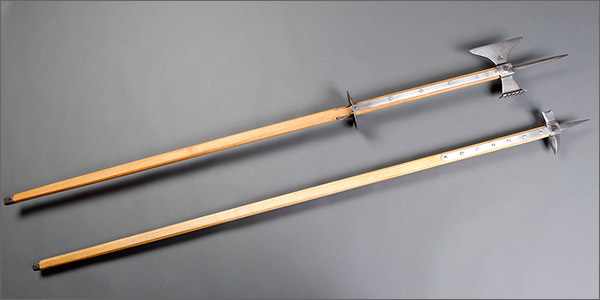
The poleaxe (aka pollaxe, polax, poll-axe, pole-axe, pole-hammer, two-handed warhammer) was one of the most popular weapons of the high middle ages. Combining the virtues of the warhammer, axe, and short spear, it was a versatile weapon designed primarily for defeating plate armour.

A hammer/axe poleaxe and a hammer/backspike poleaxe.
Description

The classic poleaxe, to my mind, is a six-foot square hardwood shaft with a hammerhead, backspike, topspike, buttspike, and sidespikes.

There are a few variations on the poleaxe, all of which revolve around the head. All will have some variation of axehead, hammerhead, and backspike. It could be axehead/hammerhead, hammerhead/backspike, or axehead/backspike. All have a long heavy-duty spike on the top, and a short spike on the bottom. Most will have a short, round hand-guard a foot or two below the head, and most will have short spikes on either side of the head.

One of the main differentiating features between the poleaxe and the very similar halberd are the langets on the sides (the metal strips running down from the head in the pictures above). A halberd head is typically forged out of a single piece, and attacked to the shaft like a spearhead via a tube and pin. The langets made the end of the weapon significantly stronger and more durable. They were part of the modular forged design of the poleaxe - each piece of the head was forged separately, which allowed a stronger construction than a single piece stretched and flattened out.

A poleaxe with an axehead would also have a smaller blade than a halberd, the better to defeat armour.

Similar Weapons

The halberd, lucerne hammer, and bec de corbin are all pretty much the same weapon as the poleaxe. The differences are basically just in head design - halberds always have axeheads and backspikes, lucerne hammers and bec de corbins always have hammerheads and backspikes.

For game purposes, I believe it's totally reasonable to treat all of the "complex" poleweapons as poleaxes - glaives, voulges, bills, partisans - all of those wacky stick/blade combos Gygax loved so much. Yes, they're all different, and all have different fighting styles, but there are distinct similarities that set them apart as a category.

Offence

The complex polearms, as exemplified by the poleaxe, are generally good for both utterly devastating two-handed swings and powerful thrusts. For an idea of the force involved, imagine smashing a melon with a baseball bat. Now imagine the baseball bat is twice as long and has a metal hammer head on the end.

The poleaxe can easily pulp the skull of an unarmoured man, the axehead can sever limbs, and the topspike can easily force its way between the links of chain mail. The topspike even has a chance of piercing through a breastplate.

The guards and actions of the poleaxe are something of a hybrid between the longsword and the spear. Its use is also something of a hybrid of the two, the main difference from the longsword being the extended reach and the ability to trap the opponent's weapon with the complex head. The main difference with the spear is the equal focus on striking and thrusting.

This guard is shared by the longsword, poleaxe, and major league baseball. Fiore calls it the "Guard of the Woman" (Posta di Donna). Much like a baseball player, the master is prepared to swing the axe around with a hip rotation, imparting devastating speed and power to the axehead.


Defence

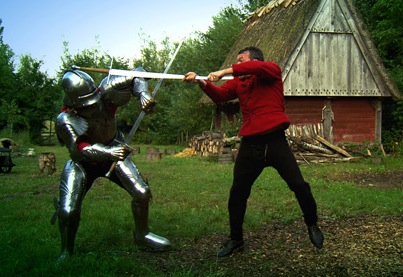
As the poleaxe is typically used by a fully armoured man against another fully armoured man, grappling is integral to defense, as even with a poleaxe it's not always easy to down a man in full plate harness. It's not uncommon for two combatants with poleaxes to get their axeheads tangled on the ground and abandon their poleaxes and switch to their daggers or to attempting a throw.


A combination axe/grappling play. The scholar (on the left) has obtained a key (a type of arm hold) on his opponent, immobilizing him for a counterstrike.


Otherwise, much like with offense, poleaxe defenses can be similar to spear or longsword plays, either seeking to knock the opponent's weapon offline and thrust, or to beat aside and land a strike.


30 November 2013

Real-world Weapons: The Spear

The spear is, without a doubt, the most popular weapon of all time. From the dawn of time until WWII, the spear was issued in vast numbers to the common soldier. Surprised to hear that WWII soldiers were issued spears? Well, a rifle with a bayonet on it is functionally a short spear. Bayonet techniques owe a heck of a lot to medieval spear techniques, which, I'm sure, owed a lot in their turn to Stone Age spear techniques.

The reason for this is simple, and two-fold: the spear is cheap and easy to make, and it is extremely effective. I've said it before, and I'll say it again: it's not for nothing that the spear is the King of Weapons.

Description

I'm not sure this is really necessary, but...

The most basic spear is simply a sharpened stick, 5-8 feet long. At it's most advanced, the spear has a steel bladed head, 18" long, with lugs at the bottom of the head, a sharpened steel buttcap on the base, and a polished and lathed ash shaft 6-7 feet long.

The butt cap is an important point - many people don't realize that medieval spears have a sharpened steel spike covering the bottom. This makes the spear significantly more dangerous than if it only had the bladed head at the top.

A spearhead and buttcap.


The lugs allow some more parrying options, but they're certainly not necessary. Fiore's spear treatise doesn't show them except in the bit on a spearman vs. a horseman.

Spearhead with lugs.


Offence

Offence with the spear is really fairly simple - insert the point into the face of your opponent. Keep in mind, though, that the spear has a point on both ends. Since any defence against the spear will involve knocking the spearhead offline, a common tactic is to absorb and use the energy from that knock to spin the spear 180° and attack with the buttspike instead of the head.

Much of the stuff that applies to the halfsword (discussed in my earlier post on the longsword) also applies to the spear, as halfswording is really just turning your longsword into a 4-foot spear.

There is currently debate about whether the spearhead or spear shaft were used for striking as well as thrusting. There is little direct evidence for spears being used for striking, but arguments can be made for it. Viking sagas speak of "hewing spears" which were used for cutting. What these are is unknown - it is possibly just a normal spear, a spear with a long head, or something more like a glaive or naginata (i.e. a sword on a stick, as opposed to a spear, which is more like a dagger on a stick).

From handling spears, I can safely say that being bashed with the end would be pretty awful. I have little doubt that a solid hit from a spear could break bones in an unarmoured target.

There's also the fact that in Fiore's medieval fighting system there's a certain universality to the techniques - since the sword can be used like a spear, it's not unreasonable to see the spear sharing some techniques with the sword.

Wiser people than me disagree the the spear is used for bashing, though, so take the notion of bashing with the spear with a grain of salt.


Defense

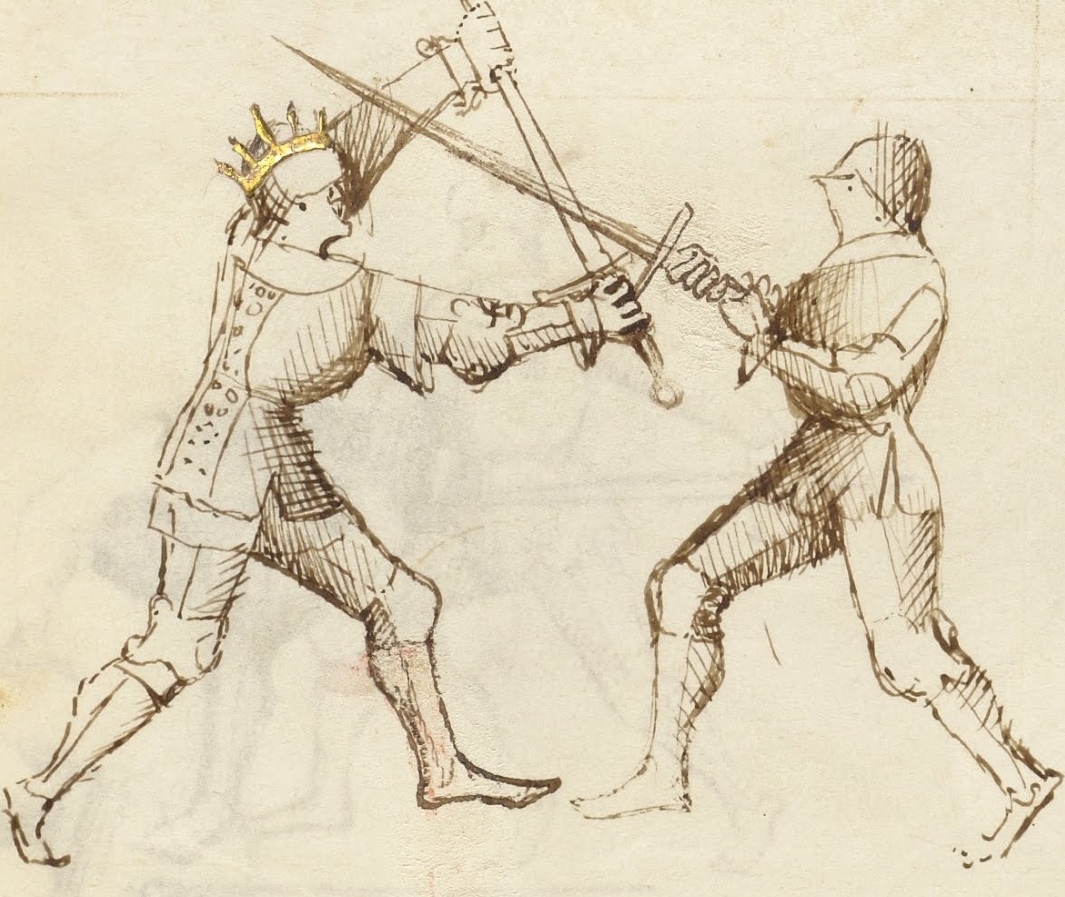
Striking sideways with the spear definitely comes into play on the defensive. Most of Fiore's spear guards have the point off the line, pointing up, back, or to the side. The point-forward guards, while having the point forward, can still generate significant sideways force with a passing step.

The master (in the crown) stands in a typical defensive guard. His point is facing away from his opponent so that he can swing it around forcefully to knock his opponent's spear aside. Note that the combatants are depicted much closer than they would really be standing in combat!


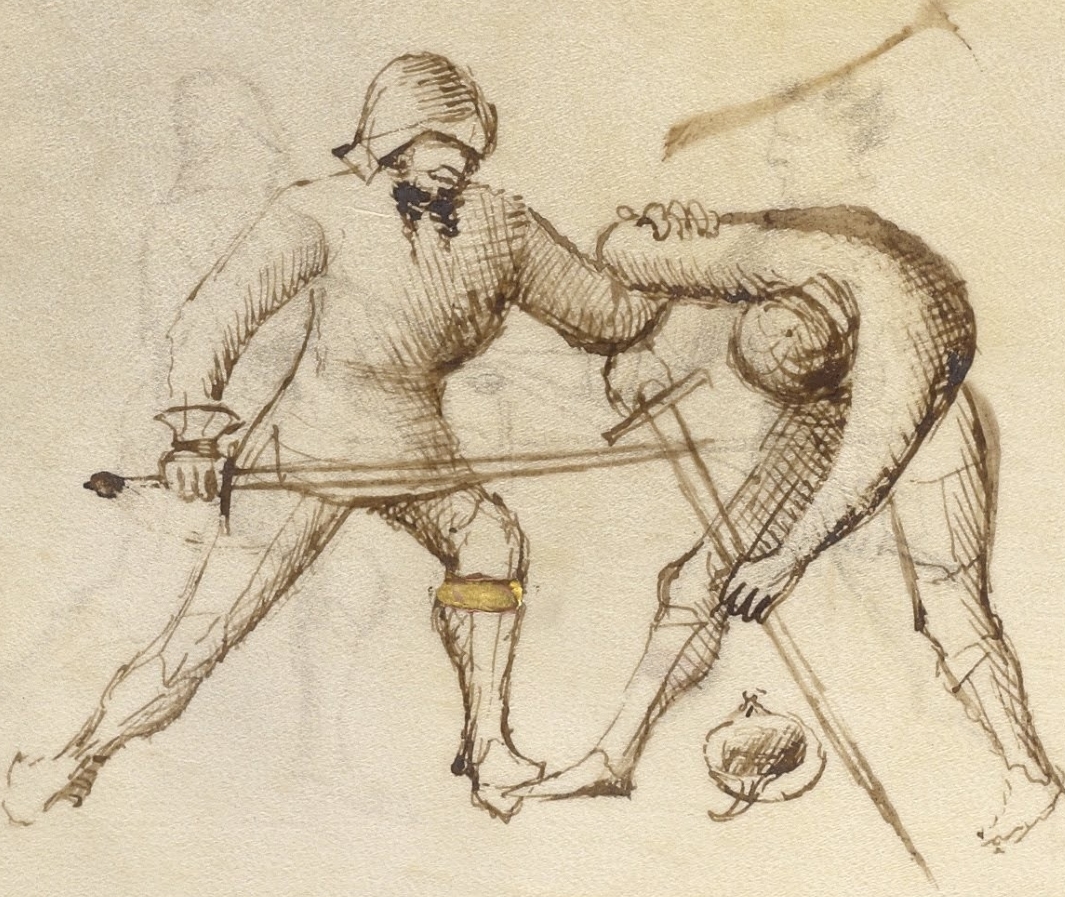
The basic defence with the spear is to turn and swing your spear to strike the opponents weapon aside, ending up in a position where your point is directed at the opponents face or neck and your spear is between you and the opponent's weapon. If you over-parry (i.e. your spear keeps swinging past their face), you can keep that energy going and turn the spear right around and strike their face with the butt spike.

The master has successfully parried from the previous position. The momentum of the opponent's attack has carried him right onto the master's spear.


4 September 2013

Noisms is a Great Guy, Whatever Our Differences

Some of you may have followed the spirited and at-times-heated debate between Noisms (of Monsters and Manuals fame) and I regarding rigid vs. flexible round lengths recently.

I just wanted to put out there, though, that whatever our minor differences may be, I've enjoyed Noisms blog over the years and we actually have a lot of common ground. I'd go so far as to say we agree on more than we disagree.

In that spirit, I thought I'd share and comment on some stuff I've really like from his blog, as a sort of peace offering.

http://monstersandmanuals.blogspot.co.uk/2011/09/yes-i-just-collated-loads-of-stuff-from.html

I couldn't agree more with all of this. Especially the bit about recreating basic monsters - I realized some time ago that the "stats" of a monster are almost irrelevant. What they look like, what they want, what they do, how they think - that's the meat and potatoes of a monster entry.

One of the main monsters from the megadungeon I use for one-offs and con games "stat block" would look like this (using the BECMI rules):

1 HD (4 HD queen)

That's it. That's the "stat block". They're a 1 HD monster, their leaders are 4 HD. But what makes them different than a goblin or a skeleton is their "skin".

These little guys live in swarms. They're made of shadow made flesh. They hate light and their feces are darkness. Their lair houses a queen and bajillions of inky black eggs. No light can penetrate their lair - too much of their light-sucking feces adorn the place.

Stats don't matter much.

http://monstersandmanuals.blogspot.co.uk/2008/11/armour-combat-descriptions-and-one.html

Leaving aside the one-minute round as a can of worms that doesn't need to be opened again, everything else in this post is rock solid.

The comment that most deaths of heavily-armoured men were execution-style slayings of men who had fallen or been thrown to the ground is something that plays right into my current thinking about damage and grappling.

Currently, as I play things, unless you bleed out or suffer a mortal wound, you can keep fighting. Bleeding out takes much longer than most fights (unless you've suffered many wounds), and mortal wounds are exceptionally rare for an armoured man.

Thus, the main way to actually kill someone is to throw them to the ground, and murder them while they're more or less helpless. Just like at Agincourt.

http://monstersandmanuals.blogspot.co.uk/2012/08/advanced-fighting-fantasy-and-d-quick.html

For a quick and dirt mass combat system, this would work just fine.

I've dabbled off and on with something similar, but it would probably end up being a little more complicated than this, and that definitely gives this system the edge for a game where mass combats don't come up too often.

http://monstersandmanuals.blogspot.co.uk/2011/10/dynamicnested-encounter-tables.html

I love noun verbing noun encounter tables, and I think this is one of, if not the first, that I came across.

I similar tables as one of the main encounter tables in the wilderness regions of my ongoing campaign.

2 September 2013

Noisms and D&D Combat

Passages in italics are quotations from Noism's post D&D Combat is More Abstract Than You Think, which kinda got me riled up, so I apologize in advance for the acerbic tone.

...it's important to remember that the D&D combat rules evolved in a context of a 1 minute combat round: in OD&D and AD&D 1st edition, the combat round is a minute in length.

OK, but 1-minute rounds are just stupid. Just because it was in 0e or 1e doesn't mean it made any sense, or that it's good game design. There's any number of things in the old editions that are stupid and that have been houseruled away by generations of gamers.

One of the big parts of the OSR is our willingness to deconstruct the rules and modify them to suit us, not point to them as gospel.

...the famous idea of Gary Gygax's that a D&D fight should resemble the sword fight between Robin Hood and Sir Guy of Gisborne in the Errol Flynn iteration.

Firstly, the notion that Errol Flynn-style combat is worth emulating is far from a universal notion. It bears no similarity to reality, it has no real risk or danger, and is extremely ill-suited to a dice-driven system like D&D.

That kind of combat exists for one purpose only: advancing the plot of a film. It's more the kind of combat you see in a story game, where the relative advantages and disadvantages in the fight reflect and comment on the dialog of the characters, and no-one gets hurt or dies except for maximizing the dramatic effect.

It is literally the exact opposite of old-school D&D combat, which is random and messy - people die and get hurt with no consideration for what that might mean for the "story". The dice reign supreme, as opposed to the story.

D&D combat bears exactly zero similarity to that style of combat, and that combat bears exactly zero similarity to real life (except that there are humans, and they have swords). That Gygax said that says it was his inspiration says little about his knowledge of combat or game design.

So much for the idea of Errol Flynn combat.

You're rolling to see if, over the course of 1 minute, you manage to wear down your opponent's defences, either through actual physical damage or moral 'damage' or exhaustion or whatever.

Your hit points represent you capacity to stay in the fight, which slowly gets reduced over time (the higher your level, the longer this takes).

I covered this in my recent post on Hit Points.

Hit points exist as a proxy for your defensive abilities, not your physical or mental stamina, or physical ability to absorb damage. The notion in (0e, at least) was that a single blow would kill a normal person about half the time - that is to say, you essentially don't have any HP, you are simply killed by a single hit and have a base 50% chance of "save vs. death".

This can be seen as an evolution from the Chainmail 1 hit = dead every time, no chance to survive. The move to D&D gave you a 50% save vs. death built-in.

So HP are, in a real sense, nothing. Trying to map them onto stamina or morale or life force or blood pressure doesn't work, as they're a statistical increase to the average life expectancy, nothing more.

And your movement rate, which seems absurdly slow, represents the fact that you are scooting around and manoeuvring for position while avoiding blows, missile attacks, what have you.

There can literally be no defense of 0e's absurdly low movement rates. There is no way you can slice them that makes a lick of sense.

They are most likely an error in the move from Chainmail mass battle to D&D single combat.

The fact that only one or two shots are permitted in a 1 minute round indicates that the archer is waiting to pick his moment to fire.

There's probably a reasonable middle-ground between 1 arrow every 6 seconds to 1 arrow every 60.

If you're taking a minute for an arrow, though, that's definitely excessive. Your odds of hitting are going to be much higher sending more shafts downrange than waiting for that "perfect chance" that may never come.

I would question why there really needs to be even an arbitrary length to a combat round of 1 minute.

Yes, and - as I said before - I agree. If you interpret D&D combat as you clearly do, then do away with rounds altogether. Just make an opposed d20 roll to see who wins.

What is the purpose of a combat round? It gives a chance for everybody to decide what they want to do and then act.

Well, it's supposed to give a way to direct a continuous action in discrete steps. As such, you need to know how long the step is going to be so you can plan your action.

It doesn't matter: there is no credibility to stretch because we are not dealing with a system which has to make sense in the way that a less abstract one does. We are not rolling dice 'to hit', despite the name: we are rolling to see how far we attrit (that is a word: I looked it up) the opponent.

If character A can attrite (I've always seen it with the 'e', but apparently both are used) character B by an average of 3 'units' per 10 seconds, then yes - it does matter one hell of a lot how long a round is. If character B has 10 'units' to attrite away, then he can last 4 rounds of 10 second, or less than 1 round of 1 minute.

I don't see how this is so hard to grasp...

Whether you're using a highly abstract system or a highly detailed one makes no difference, unless you're abstract to the point of story-gaming.

Another good reason for preferring abstract combat is just that realism may be something of a fool's errand.

It may be, but as I wrote before here, realism is to be infinitely preferred to not-realism (all other things being equal).

The short version, for the lazy, is that if the system isn't realistic, then the players need to master the system to make sensible choices. The more realistic the system, the more the players can leverage their knowledge of the real world.

For example, in reality, dropping a 25lb 10ft down onton someone's head would probably at the very least stun them, and possibly knock them out cold, maybe even kill them.

In D&D, it would have one of two effects: none, or kill them stone dead. Since that's not what would happen in the real world, a player needs to know the system well enough to understand that even though in the real world X would happen, Y will happen in the game.

I really like the idea of Western Martial Arts but I'm not persuaded that they are entirely realistic; until people start actually fighting to the death using these techniques, and agreeing that if they are injured they will only use medical techniques that were in use in the 14th century, I think that "what happens in a real sword fight" is still a matter of considerable conjecture and will likely remain so.

Sorry, but that's just ignorant. I don't really know what else to say to that.

Your ignorant, uninformed opinion based on literally nothing compared to 30 years of dedicated scholarship and experiment? It's easy to see where the weight of evidence is, and it's not on your side.

I mean, what would you think if I said something like (I seem to recall that your field is philosophy of law, or something related - apologies if it's not), "I really like the idea of the philosophy of law, but I think that scholarship in that field has revealed nothing and that everyone who has ever studied it has completely wasted their time"?

That's literally what you just said about students of historical Western martial arts.

31 August 2013

Hit Points: What the REALLY Are

I previously wrote that hit points don't actually represent anything.

That's true, but it ignores the role they play in the mechanics of the system.

See, it's absurd to think that as a fighter progress in martial arts that they improve only at attacking and not at defending.

The obvious solution is a straight-up Red Queen scenario where every level the Fighter gets +1 Attack and +1 Defense. For whatever reason, D&D didn't do that, and has forever confused people since.

What D&D does is increase your Hit Points as a proxy for your increasing defensive abilities.

To understand this, we have to recall that in Chainmail, one hit equals one kill. Heroes take four hits, and Super Heroes take 8. Notice that it's no harder to hit Heroes - simply harder to kill them (or so it seems).

But is a Hero really any harder to kill than a normal man? Of course not. Sever his spine and he'll die like the rest. What he has is exceptional defensive ability that allows him to turn aside three blows that would have killed a lesser man.

Remember that in 0e, every hit die is a d6, and every damage die is a d6. This means that one die of damage (on average) removes one Hit Die. So your Level 1 mook is dead in one hit, and your Level 4 Hero is dead in 4. Just like Chainmail (but a little more random).

So it's clear that increasing HP is a proxy for increasing Defense (or AC, as D&D calls it), and nothing else. Every Hit Die is really a mulligan representing your increased ability to defend yourself.

How to reconcile this with healing rates and whatnot? You can't. That's because this is a stupid way to do things that causes no end of confusion, and is a prime example of an overloaded mechanic (i.e. HP is both life force and defensive ability).

29 August 2013

The Absurdity of the 1-Minute Round

I was reminded in a discussion on G+ with Noisms that some people still use the 1-minute combat round from 0e and 1e, in favour of the significantly more reasonable 6-10 second round of other editions.

Let me start off by saying I have seen a lot of swordfights, something that can't be said of Gygax and Arneson. Further, I've read a fair bit about medieval combat (I am far from an expert, but again - much more so than Gygax or Arneson).

Let me state it plainly: 1-minute combat rounds are absurd.

I don't think I've ever seen a swordfight that took more than 1 minute to resolve. Allow that people may be more timid with sharp swords in a fight to the death (but then again, they may not - timidity is death in a fight), and let's say 3 minutes at the outside for a 1-on-1 fight with sharp weapons.

Examples of Combat

OD&D says that two 2nd-level fighters with plate and longswords (+1 Attack, ~7hp, AC 3, 2d6-TH using the usual houserule for 2-handed weapons) do an average of .9 damage per round, so the combat will take (on average) about 7-8 rounds to complete.

Nearly 10 minutes of straight combat in full armour just to take out ONE GUY? Nope, sorry. Not buying it.

But switch the exact same fight to 6-10 second combat rounds, and everything makes sense. Now those 7-8 rounds is more like 1 minute of combat in armour - totally doable, and in line with what I would expect in real life.

Examples of Movement

There's also movement to consider. With a 1-minute combat round, your top movement speed should be something on the order of 500-750 feet (jogging or running) or 250 feet for basic walking.

What we actually see in 0e is a standard move for an armoured man of 12'/round, or a max of 24'/round (as it says you can move at double speed during pursuit/flight situations, so presumably this is running).

Well, I'd say Gary didn't own a sliderule, as that running pace is the stately speed of .44 km/h - about one-tenth of normal walking speed (edit: originally said half, for no apparent reason). That's for running, remember. Normal walking speed for an armoured man is one-twentieth normal walking speed. (edit: corrected similar math mistake).

I've written elsewhere (here and here) about this, so this is really only a brief recap. Suffice to say that if you're using 1-minute combat rounds, the movement speeds are just absolutely laughable.

Conclusion

1-minute combat rounds don't match up with real combat durations, and make the math for movement speeds absolutely ridiculous.

Both of these problems are solved by moving to a ~6-10-second combat round.


24 August 2013

Real-world Weapons: The Longsword

In many ways, the longsword is very similar to the arming sword. It's a little longer, and a little heavier, but it actually performs rather differently.

Description

Your basic longsword is about 4 feet long and about 3 lbs in weight. Longswords are built either for unarmoured or armoured combat, or built to make a compromise between the two.

Longswords built for armoured combat have a stiff blade, aggressively pointed. This is to facilitate the powerful thrusts required to defeat armour. The last few inches will be very sharp. Designs differ, but there will often be some provision for grasping the blade with your off-hand (this is known as "half-swording") - either the whole blade will be sharp save for a hand-sized portion in the middle of the last third, or only the tip will be sharp. Some longswords designed for armoured combat will have the quillons sharpened to points, to allow devastating quillon punches and mortschlags (more on that later).

An armoured man holding his sword in "half-sword".


Longswords built for unarmoured combat will have a more flexible blade, sharp all the way down. It may not be quite as aggressively pointed.

I'd like to clarify that the "unsharpened" portions are not totally dull, they're just not nearly as sharp as the rest of the sword.

Misconceptions

The longsword, despite being a weapon of status, was not typically the primary battlefield weapon of armoured men, who typically preferred spears or poleaxes. The longsword was primarily a sidearm or a self-defence weapon.

Much like the arming sword, the cuts are delivered by pushing the balance point forward not with big swinging arm movements - . The big difference with a two-handed sword is that you do a "lever" action with your two hands, moving your right hand forward and your left hand back to snap the tip forward faster and more powerfully.

Offence

While half-swording (illustrated above) is possible with an arming sword, the extra 8" of blade (the other 4" of increased length over an arming sword is in the handle) really does make half-swording a longsword more viable.

Half-swording basically turns your sword into a small spear, and many of the spear plays are possible with the half-sword. It provides a powerful defence that can easily transition into a powerful thrust, and because it gets you in close, it puts you in a great position to enter and get into grappling.

Both Fiore and Vadi say, "the sword is an axe". While this statement is rather cryptic alone, by looking to the German tradition, we see a technique called the "mortschlag", or "murder-blow".

From historicalfencing.com - a mortschlag delivered to the vulnerable back of the shoulder.

The mortschlag involves grasping the blade with both hands, and swinging the sword exactly like an axe or mace. Ringeck advises that mortschlags be delivered to the foot, the hand or arm, or to the back of the hip or shoulder. Tallhoffer (I think - I know some of my readers are better versed in the German tradition than I am, and will surely correct me) describes used the crossguard to hook and disarm from  mortschlag.

The other side of the comment "the sword is an axe" is, in my opinion, that the sword and the axe share, amongst the knightly weapons, that is equally capable of thrusts and blows.

The other thing worth mentioning is that the sword can be used as an extra lever in holds, locks, or disarms. The point of the half-sword can be slipped between the arm and the sword and twisted for a disarm. If you can get behind your opponent, the sword can be held against their throat with a hand on the blade and one on the handle for a choke-out, severe neck wound, or a throw. When applying certain keys, the sword can be used to help lock up the arm and provide additional leverage for a break or throw.


Defence

In defence the longsword is used much like arming sword except at the half-sword, so that's what I'll discuss here.

Much like the spear, the half-sword can be used to knock a blow or thrust aside and immediately counter with a thrust of your own, or blow right through into a pommel/quillon strike.

From this block, you can turn your sword to the right, simultaneously displacing your opponents sword and directing your point at his face or neck, or come to a grapple as we see below.

Once you've blocked or parried at the half-sword, you're going to be very close to your opponent, and many defences in armour revolve around grappling. A man in armour is extremely well-protected, and throwing him to the ground is a great way to neutralize that advantage. Working at the half-sword facilitates this.

Coming to an arm lock - the opponent can be forced to the ground from here. If they strongly resist the throw, their arm will break.


From here, you can throw your opponent to the ground by pushing back on his head with the tip of your sword. Obviously, if he doesn't have good neck protection, he'll be severely injured even before he hits the ground.


A possible follow-on from the first half-sword defense I showed - push forward and slip the sword behind the neck, then use that powerful grip to hurl the opponent face-first into the ground.


19 August 2013

The Long Road to Better DMing

Noisms recently wrote a post, the gist of which was to extol the virtues of practical experience as a GM over mere technical knowledge. It can be found here.

I would tend to agree with that, but I think an even more important consideration is being overlooked.

Noisms asks the question, "who is the better DM - the person who has only been trained in the rules or the person who knows the rules but has 10 years' experience at the table?" He and I agree that it will likely be the person with more experience.

But an even more important question is this, "who is the better DM - the person whose total knowledge of the world and humanity comes from daytime television and trashy novels, or the person with a rich social life who is well-read in both great literature and non-fiction?" I think the answer is obvious.

But so often gamers seem to think that the game begins with prep and ends when the last hit point is expended (Alexis at Tao of D&D is a notable exception - he has often written on the importance of being a well-rounded, well-educated human to gaming, and that is one of the reasons why I have so much respect for him). So often the importance of being a good human being is ignored.

Without an understanding of politics, economics, geography, physics, meteorology, sociology, military science, etc. etc., it is very difficult to run a convincing game world. Without extensive experience of varied social interaction and without exposure to the depths of humanity present in literature, it is very difficult to run convincing NPCs (or PCs, for that matter).

One of my favourite quotes - it was said regarding musicianship, but can be applied equally well to playing D&D - is "Remember that sitting under a tree is also good for your playing." It was a reminder that beyond the technical and the practical is the human, and D&D is nothing if not a game that is deeply human.

So, get out there - read Dostoyevsky. Watch Kubrick. Experience Rodin, Mondrian, Matisse. Fall in love, argue passionately, make and lose friends.

If you want to play great games, live great lives.

15 August 2013

The Irrelevance of Initiative


Since combat is an ongoing cycle with everyone acting, the idea that people are acting in order in combat rounds is kind of arbitrary. After a full cycle, the beginning and end of the cycle cannot be determined, and therefore being "higher" or "lower" in initiative order is meaningless.

An example. Consider this initiative order:

Bill
Wilma
Orc #1
Steve
Jane
Orc #2
Ogre #1
Phil

Now, look at how the initiative for a 5-round combat looks:

Bill
Wilma
Orc #1
Steve
Jane
Orc #2
Ogre #1
Phil
Bill
Wilma
Orc #1
Steve
Jane
Orc #2
Ogre #1
Phil
Bill
Wilma
Orc #1
Steve
Jane
Orc #2
Ogre #1
Phil
Bill
Wilma
Orc #1
Steve
Jane
Orc #2
Ogre #1
Phil
Bill
Wilma
Orc #1
Steve
Jane
Orc #2
Ogre #1
Phil

For the bulk of the combat, there's literally no way to know if Bill is going first, or Ogre #1, or Wilma, or Phil. Each person just goes after the previous one. If you allow actions to change your initiative order (i.e. "held" actions), then the whole concept becomes even more meaningless.

On top of that, going first is not necessarily an advantage, due to the artifacts of a turn-based system.

Consider Wilma and Bill, both Level 1 Fighters with 3HP and d6 damage weapons. Their movement is 30' (for the purposes of the example).

If they start 35' apart, the person who goes "first" is actually at a serious disadvantage - if they move up at all, the other will be able to then move up on their turn and strike them. If the blow connects, the odds are even that it will kill them, and the fight will be over.

This is why I prefer to do things this way:

I describe the beginning of the action of each opponent (i.e. Orc #1 is moving towards Bill, Orc #2 is moving towards Jane, and the Ogre is preparing to throw a rock).

Then the players say what they intend to do:

Bill: I'm going to draw my sword and fight Orc #1.
Wilma: I'm going to help Bill.
Steve: I'll cast Figface on the Ogre.
Jane: I'm going to flip the table to block Orc #2's advance, and look for my Horn of Fury in my pack.
Phil: I'll defend Jane while she looks for the Horn.

Then we just go around in whatever order is convenient (typically clockwise) and adjudicate the results, with the idea in mind that this is all happening simultaneously.

I don't find that it's any harder to do things that way than it is with an initiative system, it's a lot more satisfying, as the players get to make informed choices based on a hint of what the enemies are going to do, and it avoids all the weird artifacts of a turn-based system.

This system is similar to some strategy games on the market, such as TacOps 4 - there are "order phases" where the game is paused and players issue orders, and then "battle phases" where the game runs in real-time for, say, 1 minute of game time (during which time orders can't be changed or given).

31 July 2013

Real-world Weapons: The Arming Sword

Description

The "Arming Sword" is what I think most people think of (incorrectly) as a "longsword" or a "broadsword". The arming sword is the classic "knightly" sword of the High Middle Ages - a one-handed, cruciform, double-edged cut-and-thrust weapon with wide quillons and a heavy pommel.

Typically would be about 3' long, and about 2-2.5 lbs. Balance point is a few inches along the blade from the guard.

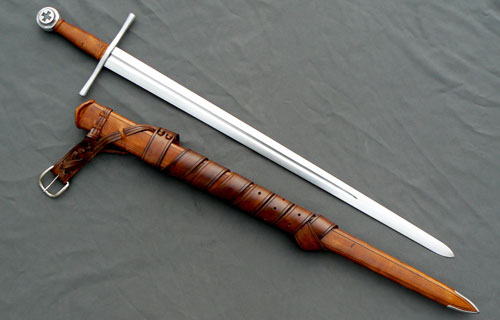
A typical arming sword with scabbard, displaying the main features of a typical arming sword - tapered double-edged blade, straight quillons, heavy metal pommel. This sword is a replica of a typical Crusades-Era sword from Valiant Armoury, but arming swords around 1400 were substantially the same. Link to the Valiant Armoury page: http://www.valiant-armoury.com/catalog/txt_CF408.html
Misconceptions

Some of these have been dispelled before, but it bears repeating. One of the main myths around swords is that they were heavy - this is not so. An arming sword would weigh a little over 2lbs - no more than 2.5lbs.

They were not the dull, heavy, metal clubs some people seem to think they were - the arming sword is nimble and sharp.  Now, the sword wouldn't be sharp like a razor blade is sharp - more like a chisel, but still sharp enough to easily cut an arm or leg off, decapitate someone - even cut them right in half. I'll have some caveats to this in my longsword article.

This is more of a general combat misconception, but sword combat doesn't take place at punching distance - two people aren't going to stand 4 feet apart bashing away at each other. Much of the fight will be at more like 10 feet, with a lot of fluid forward and back movement as the fight progresses.

A misconception I saw in a comment on another one of my posts was that you could wait for a sword swing to "go by", then rush in. This is not possible, as sword swings do not "go by". The finishing position of a sword strike that doesn't connect is with the point out in front of you, directed at your opponents neck or head.

Even if the sword did "go by", the nimbleness of a sword means that your rush would simply end with you having an arm cut off or being impaled.

Offence

The European cruciform sword is one of the most versatile weapons out there. It has cutting edges on both sides, and is straight and pointed for powerful thrusts. The quillons and pommel can be used to punch and strike - some swords even have sharpened quillons for more powerful quillon punches. In a pinch, it can even be used two-handed with one hand on the pommel, although it won't have the power of a true two-handed weapon, due to the limited leverage the off-hand will have.

The arming sword can be used with a shield or buckler (as detailed in MS I.33, the earliest known European martial arts manual) or alone (perhaps more common in a self-defense situation, described in Fiore's works).

I.33 does a good job of illustrating the way you fight with sword and buckler - keeping the two together, moving them as one weapon, using the buckler to cover your sword arm as you attack. You still are mainly using your sword to defend yourself - the buckler is there to help. I'll write more about shield combat when I get to shields. Suffice to say at this point that 1 point to Defense is undervaluing shields significantly.

Using the sword by itself opens the possibility of grappling with your off-hand - after you or your opponent make a successful cover, you may have an opportunity to grab the pommel of their sword, lock up their arm in a key or a bind, or even get really close and throw them to the ground.

Successful attacks with the sword are seeking to place a thrust in the head or neck, or less optimally in the chest (as the ribs are much harder to get through). With cuts, you can strike a near-vertical stroke down, looking to hit the head, or the base of the neck. Horizontal strokes can be aimed at the head, neck, or arms (preferably the sword arm, as chopping that off will instantly win the fight).

Rising strikes are typically aimed at the hand or arm, as their reach and power is less (and it doesn't take much force to lop off a finger), but they can easily be turned into a thrust at the end.

Defence

Defences with the sword are ideally seeking to displace the opponent's blade and make a strike or thrust at the same time. In the broadest sense, same counters same. A downward blow from the right shoulder will deflect a downward blow from the right shoulder. A thrust to the face counters a thrust to the face. If this was all there is to it, swordfighting would be a piece of cake - obviously, there are many other options.

Fiore describes a "universal defence" using the sword in one hand - stand with your right side to the enemy, sword down and back pointing past your left foot. Against any sword attack, you can step offline and cut into the attack, deflecting it and positioning yourself in a great place for a counterstroke. Interestingly enough, the starting position for this is basically leaning away from your opponent with your sword in its scabbard.

If a defence ends up with the swords bound (i.e. stopped edge-to-edge), you have a number of options - wind your sword around theirs and strike, grab their hand or arm with your off-hand to control their sword and strike, disarm them, slam them in the face with your pommel or quillon, a kick in the knee or groin...


30 June 2013

Real-World Weapons: The Axe and Mace

Difficulties

I must admit, I am significantly less familiar with the short unbalanced weapons than I am with, say, the sword and spear. Additionally, there are no period texts detailing the use of the mace or the short axe. Dagger, sword, spear, poleaxe, yes - axe and mace, no. So much of what we can say about these weapons is speculative.

What we can do is look at surviving specimens and accurate reproductions to get a sense of what the weapons were like, physically.

Descriptions

A standard European mace. This is likely a little out-of-period for me, likely c. 1450-1500, but is substantially similar to earlier models. Image courtesy of Nazanian and Wikimedia Commons.
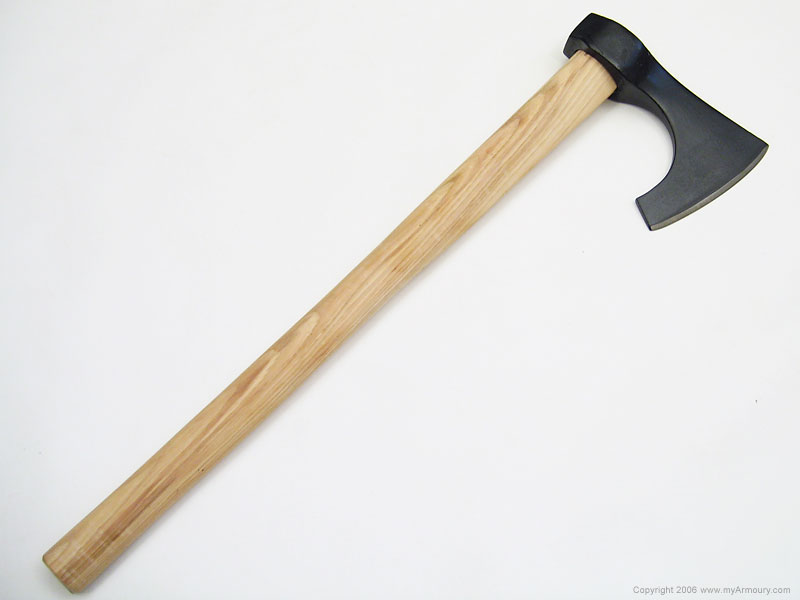
Replica battleaxe, based on an archeological find in Norway. Reasonably typical of battleaxes in general. Photo from myArmoury.com, axe by Arms & Armour.

First off, these weapons are shorter than I had previously thought - one handed maces don't seem to vary much from the 24" mark. They're also lighter than I had thought - rarely more than 3 lbs, and often only 2 lbs - sometimes less. The same goes for axes, although they tend to be a little smaller and lighter still!

The balance point ranges from the middle of the weapon to a little past the middle (i.e. closer to the head). It looks like the balance point would be further, but there you are.

This all contributes to making maces and axes significantly handier in combat than you might expect.

Mace - Description

The difference between a mace and a club is subtle. To my mind, the defining features of the mace are two-fold: all-metal construction, and the use of flanges or knobs on the head.

Length: 20-30"
Weight: 2lb
Balance point: 2/3 up from butt end.

Mace Variation - Morning Star

The morning star is simply a mace with spikes instead of knobs or flanges, especially if there is one larger spike at the very top for thrusting.

Axe Description

Military axes had very small, thin, light heads compared to woodcutting axes or hatchets. The head would also often have a cut-out between the blade and haft, allowing for the axe to be used for hooking, and reducing weight while maximizing cutting area.

Length:18"-30"
Weight: 1-2lb

Axe Variation - Military Pick / Warhammer

A military pick or warhammer are basically just piercing or bludgeoning versions of the axe. Some axes even incorporate a pick on their back end, and most warhammers have a hammer side and a pick side. Otherwise, they are very similar to an axe. 

Misconceptions

It seems to be a common misconception that maces and axes were big, heavy things that dealt damage through their weight and brute force. The reality is that they were usually smaller and lighter than swords, and relied as much on the speed of the swing as on their unbalanced weight distribution.

Offence

Archaeological evidence shows that people killed by axe blows were typically struck from above, leading me to believe that fendente (i.e. overhead strikes) were more typically used with these weapons than mezzane (strikes parallel with the ground). Logically, this makes sense - gravity would be pulling the heavy head of the weapon down, lending more force to the blow for free.

The other common injury with axes seen is leg injuries. This is likely because axes were used with shields - two fighters with shields apparently find opportunities to hook the axe under the opponent's shield. Later treatises of the sword don't describe leg strikes - they focus on attacks to the head, neck, and weapon arm.

Defence

A dagger play that might be usable with an axe. From the Pissani-Dossi MS of Fiore Dei Liberi's manual.


Two more dagger plays that might work with an axe or mace. From the Paris Manuscript by Fiore Dei Liberi.


If using an axe or mace with your other hand empty, you could possibly do some dagger/baton defences with the shaft. The problem immediately apparent in adapting these plays is that axes - while they can thrust - are not suited for the devastating thrusts to the vitals that daggers are capable of.

It may be possible to do some of the sword defences, but the short shaft and lack of guard would limit your options there. While handier than you'd think, an axe or mace is not going to be a great option for your only defensive weapon.

Except in urgent situations, typically an axe or mace would be used with a shield. This makes up for the lack of agility compared with a sword - at least compared to a sword without a shield.

26 June 2013

Real-World Weapons - The Dagger

I'm starting a new series on Real-World Weapons - i.e. the weapons we know and love from D&D in a real-world context. I hope that this series will illuminate the use of these weapons to the reader, enabling players to employ more varied, effective, and realistic tactics in battle, and helping DMs deliver vivid fight scenes that have the ring of truth to them. 

I'm starting this series off with a weapon that doesn't get a lot of love (outside of Magic User circles) - the dagger. I'll be continuing on with the short, unbalanced weapons (axes and maces), then the swords (arming and long), and eventually the polearms (spear and poleaxe). I may do more later on, but most other weapons are pretty similar to one of these - enough that they can probably be treated the same mechanically.

Description

The medieval dagger of the period was about the size of a really big carving knife - the blade would be about 12"-18" long, with an extremely stiff blade. It's primary purpose was piercing, but it would typically have at least one sharp or semi-sharp edge.

Rondel Dagger c. 1350 found in the Thames River, London - image from Wikimedia Commons, courtesy of Dana Williams


Offense

Daggers typically deal low damage in RPGs, to distinguish them from the bigger weapons. I would posit that the 0e system of d6 across the board is not that far off. All Medieval weapons were more than capable of killing a normal, unarmoured man outright in a single blow, and this is how Oe works.

The 12" blade of a dagger can do some really serious damage to the human body. A blow to the head will pierce the brain, likely instantly killing the victim. Neck shots will sever arteries, cut the windpipe, or damage the spinal cord. Blows to the trunk are typically less useful, as the ribcage is pretty tough, but a blow that comes down through the collarbone or between two ribs could easily puncture a lung. Stabs to the abdomen can pierce the liver, kidneys, or other vital organs, leading to rapid death from internal bleeding.

That said, many of the blows from a dagger would be to the hands and arms, where they would be painful and dangerous in the long run (i.e. slow bleeding and infections), they likely wouldn't put you out of the fight. Glancing blows will slice the victim up, but again, likely not enough to put the person out of the fight.

This is my justification for giving the dagger 2d6-TL (2d6 Take Lowest) - enough that it can be very dangerous, but blows from it typically will not kill you.

Usage Vs. Armour

The Medieval dagger was also a valid tool against an armoured opponent. Its stiff blade and sharp point made it ideal for forcing through chain mail, and it can still be used in a grapple once other weapons have been abandoned.

In a close fight between armoured opponents with daggers, each will be seeking a weak point to drive it in, and there are a few choice targets. Depending on the helmet, there may be some great targets on the head.

If the helm is unvisored, like the popular kettlehelm or early bascinets, the face has only thin bone between blade and brain, and is an excellent target.

If the helm is visored, like the popular hounskull bascinet, it may be possible to open the visor and attack the face.

Lastly, if the helm is one solid piece, like a greathelm, the eyeslits can be a target. This is probably most practical if the victim is pinned on the ground, limiting their head mobility, as the eyeslit is a very small target, and they often had flanges to direct thrusts away from them.

After head strikes, the neck is another good target. In-period, the neck was often defended by a plate gorget (which would be more or less impermeable), with or without an aventail of mail around it. In a very close grapple, the attacker might be able to lift the back of the aventail, and get his dagger in the back of the neck, severing the spine or major arteries, or plunging the blade down in the hopes of hitting the heart or lung.

Barring any of those options, the armpits were typically only armoured with chain, which a dagger could be forced through.

Defense

Plays of sword and dagger, from the Getty MS Ludwig XV 13, by the Master Fiore Dei Liberi c. 1410.

While the dagger is rather small, it is not useless for defending yourself - anything that you can directly control an enemy weapon with is better than nothing!  In fact, you can make most of the dagger defenses with any kind of similarly-shaped object - a stick, for example.

I've rated the dagger's defensiveness as low, because it is so small it's easy to screw up your defense, and it can be overborne by powerful weapons like the poleaxe.

A defender with a dagger facing someone with a superior weapon would be trying to do a few things, typically.

Controlling the opponent's weapon is always the first priority, as killing them is little good to you if they kill you at the same time. The dagger doesn't offer the leverage of a sword, or the reach to strike from the bind (i.e. weapons crossed). Therefore the person with the dagger will likely try to transfer control of the opponent's weapon from the dagger to their offhand after parrying an attack.

From there, they can seek a lock (like a key or armbar), a disarm (most viable against a one-handed weapon), probably all combined with an attempt to maneuver in beside or behind the opponent for an opportunity for one of the lethal strikes I described above.

24 June 2013

Confined Spaces

Edit: updated Longsword length to be 4', a better estimate than 3.5'.

Previously, I'd talked about reach in the abstract, without considering the space you're in. How do we deal with the restrictions imposed on fighting by a confined space? I've touched on this issue here before, in my post Dungeoneering Tools: The Spear, but I'd like to develop something a bit more general, as the subject of confined spaces obviously affects more than just the spear.

Confined Spaces

What constitutes a confined space is going to vary based on what kind of weapon you're used. A space that is "confined" for a spear could be spacious for a dagger. There are also some weapons that have options for how to fight with them - something like a longsword can be held with one or two hands on the hilt, or with one hand on the hilt and one hand on the blade (called "halfsword"). A spear can be gripped in thirds (the usual way for single combat) or with one or two hands down at the butt (for formation combat).

See below for a detailed and simplified chart of how much space different weapons need to be used effectively.

Effects of Confined Spaces

If you don't have enough space (in any dimension) for using your weapon properly, you don't get any Defense or Attack bonus for your weapon. Also, any rolls above 10 on your d20 attack roll count as a 10.

If the space is too small to wield the weapon at all (e.g. trying to use a 7' spear in a 6'x6' closet), obviously you can't use it at all.


Weapon Reach

The reach of a weapon is equal to: the length of the weapon past the hand + the length of the arm + the length of one step + a little bit for body positioning. Anything within the reach of the weapon is a potential target.

Footwork

In addition to the length of the weapon, there's also the footwork required for using it effectively. This is fairly consistent across weapons, and can probably be generalized to about one step per round in any direction.

Weapon Usage Style

There's also the matter of usage style. Spear, longsword, and poleaxe immediately occur as having a couple of options for how to use them.

Spears, poleaxes, and longswords can be held in thirds (i.e. each hand 1/3 from the respective end) or at the butt (i.e. both hands down near the end). Holding a spear by the butt gives it great reach, but limits its offensive and defensive power. Holding a spear in thirds gives its attacks and parries great power, and opens up the possibility of using the spear as a lever when grappling (e.g. a missed thrust to the head turns into an attempt to knock the person down by hooking the spear around behind their head and pulling them down).

Poleaxes and longswords can be swung when held at the butt, which for poleaxes obviously needs a great deal of room.

Space Requirements

Most weapons are going to need a radius of their reach around them, and probably space above them (approximately weapon length + shoulder height) above them.

Let's categorize weapons:

Detailed table:


Weapon

Length (effective)

Max Reach
(length + arm + step + lean)

Min width
(length x 2 + step x 2 OR step x 2 for thrusting-only weapons)

Min Height (6' wielder)
(length+shoulder height)

Dagger

1

8

8

6

Axe/Mace

2

9

10

7

Arming Sword

3

10

12

8

Long Sword

4

11

14

9

Long Sword (halfsword)

4 (1)

8

8

7

Spear (thirds)

7 (3)

10

12-16

8-11

Spear (butt)

7 (5)

12

6

6

Poleaxe

6 (2-4)

9-11

14

9


And, an extremely simplified version, because that's a lot of fiddly numbers:


Weapon

Length (effective)

Max Reach

Min width

Min Height

Dagger

1

S

S

S

Axe/Mace

2

S

S

M

Arming Sword

3

M

M

M

Long Sword

4

M

M

M

Long Sword (halfsword)

4 (1)

S

S

S

Spear (thirds)

7 (3)

M

L

L

Spear (butt)

7 (5)

L

S

S

Poleaxe

6 (2-4)

M

L

L

For this table, S / M / L:
Reach: 8' / 10' / 12'
Width: 8' / 12' / 16'
Height: 6' / 8' / 10'


19 June 2013

Reach and the Nine and Thirty Kingdoms

Continued from the last two posts, and in response to this post.

Fighting Distances


Two people in a sword fight spend most of the fight about 10' apart - the distance of one step plus an outstretched arm with a sword in it. They only move in to make a blow.

Standing any closer than that is suicide, as you won't have time to parry an incoming blow (and will be forced to try to dodge, likely throwing yourself off balance and getting killed by the continuation of the attack). I talked yesterday about how important *not dodging* is.

Managing Distance


"But on the other hand, are we assuming that combatants are too stupid to try to get inside an opponent's reach? Too stupid to knock the spear aside with their shield? It balances out."

It would seem so, but it doesn't, and here's why.

For the person with the longer reach, it's easy to maintain a longer distance. Any time the opponent gets close, you circle away from them (i.e. step sideways and back). At no point is the long-reach person threatened in this series of actions - they are still too far away to be hit.

Additionally, at any point, the person with the reach advantage can simply step forward and attempt a blow in relative safety- they can strike while they are still out of reach of their opponent's weapon.

However, for the person with the shorter reach, in order to attempt a blow, they have to achieve a tactical advantage which will let them simultaneously catch the other person off balance enough that they can't circle away, control the longer weapon as they close (so they don't die), *and only then* can they attempt a blow. Much, much more difficult.

It's certainly not impossible, but hopefully that illustrates why it doesn't "balance out".

This is also a good argument for buffing spears back up to their full length, by the way.

18 June 2013

Shields, Axes, and the Nine and Thirty Kingdoms

Continued from yesterday's post, and in response to this post.

Shields - Not For Blocking


"Also, you'd certainly be better off focusing on dodging an ax than trying to block it with a shield that's going to be hacked to bits."

This seems to be based on a misconception of what a shield is used for. Yes, in a shield wall, you use a shield for blocking.

But in a one-on-one fight, the shield is used to defend you in the same way a weapon is used - by controlling and guiding the opponent's weapon, not by simply "blocking" it. If you're holding your shield out and taking the full brunt of an axe blow with it, you're doing it wrong.

Dodging - A Good Way To Get Yourself Killed


"focusing on dodging"

Dodging is a very small part of combat, and is really more of a last-ditch defense or a way of sweetening a parry than something to be relied on. You always want to be seeking to control the other person's weapon, and you can't do that by dodging. You need to be making contact - either with your weapon or your shield, or by grabbing their hand/arm.

There's a rule of fighting - "Never be uncrossed in distance." That means don't *ever* let your opponent so close they could hit you with just a hand motion, unless you have control of their weapon.

Hollywood depictions of combat are terrible for this - the two fighters stand sword toe-to-toe and slug it out, constantly crossing and uncrossing their swords while they're close enough to punch each other. Well, in real life, both of them would end up dead doing that - being uncrossed in distance tends to lead to double kills.

Furthermore, "dodging" implies (to me, anyway) contorting your body in some way to get out of the way, something you should ideally not be doing, as it breaks your structure and makes you vulnerable. It's far better to use your weapon for defense than to rely on dodging.

But this is getting into the territory I'm going to cover tomorrow, which is Reach, and why more of it is better.

Mechanical Problems


"That's a minor in-game justification, but since the goal is something minimalist that's in between the traditional Weapon vs. AC system and "all weapons are the same", it seems reasonable."

I respect the goal, but I think that any mechanic that encourages players to have their characters behave irrationally is broken.

You would most certainly be better off facing someone with an axe with a sword and shield than with just a sword. I think that really should be obvious.

I can see, if you want to give axes something special, maybe you could have them just negate the shield bonus (i.e. +1 vs. shield). There's no real-world justification for that, but it fits with the system you're building, and doesn't encourage bizarre character behaviour (i.e. "The orc has an axe? I quickly drop my shield and charge!).

A better approach might be something like, "unbalanced weapons count for twice their length", where unbalanced means any weapon with most of the weight at the end - mostly the mace and axe.

This would serve to model unbalanced weapons main function - dealing with armour.


17 June 2013

Spears, Weapon Mechanics, and the Nine and Thirty Kingdoms

In response to this post.

Talysman very kindly wrote a lengthy and detailed reply to my comments on his search for a middle-ground between a cumbersome weapon vs. armour table and no weapon differentiation. I was going to comment on his response, but I got a little carried away, so I'm putting it here. Quotations are from Talysman, unless otherwise noted.

The Goal

 As he so often does, Talysman perfectly encapsulates one of the central problems of designing a combat system (and I quote):
  1. Weapons seem different,
  2. Each is good at different times,
  3. There are hardly any rules specifically implementing 1 and 2, and
  4. They're easy to remember.
That's sort of the holy grail, and a particular bugaboo of mine, so I'm always delighted to see other people chipping away at this problem. Now, the spear became sort of a central issue to the discussion, and I think it merits discussing the spear a little more in depth.

The Problems


Now, there's a few problems I see with Talysman's approach, some logical, some verisimilitous, and some mechanical.
  • Pole Weapons Nerfed
  • Shields Can Hurt Your Defense
  • Longer Reach Not Always Advantageous
I'm going to address these in a series of posts, starting with the first - nerfing the spear.

King of Weapons


There's a couple of reasons why the spear was the most popular weapon right up through the early gunpowder era - one is that it's cheap, and the other is that it is really, really good. Like, really good. There's a reason the spear is known as "The King of Weapons", and it's not because it wears a crown.

Now, for dungeoneering, the spear is essentially useless unless you're forming a mini shield wall. So there's good reason why everyone doesn't just use spears all the time. I talked about that here before.

But in one-on-one combat in an open space, the spear is peerless.

Spears - This One Is Supreme


"Tom Hudson said almost the exact opposite on a previous post about this. "poleaxe = good against plate, but spear = not so much"."

With respect to Tom Hudson, he's wrong. I would point to the Italian Master Fiore dei Liberi's opinion on the subject, from the end of his section on the spear in his 1400-ish combat manual:
And here ends the art of the spear, / With harness and without, this one is supreme.
What he's saying is that the spear is awesome, whether or not your opponent is wearing plate.

Fiore also specifically depicted plate armour in the illustrations for the spear section in the Getty MS, which he only does for the halfsword (i.e. using a sword like a spear to defeat armour, with one hand on the blade), the poleaxe (essentially a spear with a hammer on it), and the spear (noticing a spear-theme here?):
Spears and Plate Mail, c. 1400

So, no offense to Tom Hudson, but I'll defer to a man who literally lived by the sword and was one of the great masters of the art of combat.

Spears - Massive Force, Tiny Point


"And my gut instinct is: a spear is a knife on a stick. Stabbing/slashing weapons don't have increased force if attached to a longer shaft; they just have a longer reach. It's the hacking/bashing weapons that have increased force."

The problem with gut instincts is that they're so often wrong.

A spear delivers a great deal more force than a dagger, as you can put both arms on it and thus get much more of your body weight behind the blow as well as double the arm strength. I've worked with swords and spears doing pell drills (i.e. hitting a wooden target), and I can definitively say that a spear packs many times more wallop than a single-handed thrust.

All of this force is concentrated into the point of the weapon, and that point can do some serious damage.

8 May 2013

The 0-Level Man-at-arms

For some reason, D&D has gotten it into its head that men-at-arms would be 0-level. This trope dates back pretty far, and is taken as canon by many.

Let's examine this for a minute, though.

The historical term "man-at-arms" was used to denote a professional cavalryman in full armour. Knights would be an example of a man-at-arms, but many men-at-arms were not knights. In D&D, however, the term tends to be used to refer to any professional soldier, regardless of equipment.

In either case, though, the term refers to a professional.

The idea that a professional solder has the same odds of hitting in combat as an untrained peasant is, frankly, laughable. This professional, in fact, has lower odds of hitting in combat than your fresh-faced 1st-Level Fighter with 0 XP.

In an older edition like BECMI (my old stand-by), a professional soldier with training and experience should probably be around level 3 - greater odds of hitting, and much more survivable than an untrained peasant.

On average, a peasant (AC 9, 1-6 HP, Attack +0) will take around 5 rounds to kill a Level 3 fighter (AC 9, 3-18 HP, Attack +3). The Level 3 fighter will only take around 1 or 2 rounds to kill the peasant. The difference swells, obviously, if you give the man-at-arms armour.

Conclusions? City watchmen, mook guards, anyone with no real training - 0-level or Fighter 1.

Serious men-at-arms, with training and experience? Probably Fighter 3-5.

20 February 2013

Dungeoneering Tools: The Candle

Candles were bloody expensive. Consider that in the 14th-15th C. a cow was worth about 8 shillings, or about 96 silver pennies (basically a gp). From that cow, you could probably get 300-400lbs of meat (you can get more from a modern steer, but 600 years of selective breeding have made cows bigger), so that's about a farthing (one-quarter of a silver penny) for a pound of beef (not counting butchery, etc., as people often did that themselves back then).

Compare that to tallow candles at about 2d/lb, or wax candles at about 6d/lb.

Keep in mind, that in this period, wages for unskilled labour were in the range of 1d/day.

Making a wildly inappropriate comparison to modern-day minimum wages, that's the equivalent of paying something like $250 for a pound of candles.

So you can see why many people using rushlights (reed stems soaked in fat or pitch) or splinters (splinters soaked in fat or pitch), both of which were more or less free (if you were willing to pick the rushes and gather the pitch yourself).

But back to dungeoneering.

Candles are a not really a great source of light, probably comparable to a period oil lamp, but you can get a candle lantern for them. This helps with dazzling, and with the candle going out from the wind of walking around (seriously, that's enough to put out a candle, or at least make it pour scalding wax on your hand - candles suck).

Even a big double-wick candle isn't throwing enough light for you to see OK-ish more than about 10-15', with dim shadows twice that. Reading requires a candle to be within a foot or so.

But at least you're not blinding your friends with your torch, or worrying about spilling the oil out of your lamp.

EDIT: Forgot to include burn times. A one-pound candle would burn for about 70 hours. Not too shabby.