30 January 2014

Real-world Weapons: The Empty Hand

This is the last "melee weapon" in my Real-world Weapons series. There will be upcoming episodes on missile weapons and armour.

I lied before when I said that the stick was the oldest weapon - that honour clearly goes to the empty hand.

The man advantage of the empty hand as a weapon is that it's always available. It's also surprisingly potent.


Throws

You ask how I force others to the ground under my feet with such prowess,
I tell you that because I grapple each man and throw him down;
The victory palm is appropriately held in my right hand
. - Master Fiore Dei Liberi
I can remember a time before I studied martial arts when I wondered why throws were so prevalent - I'd fallen down before, and it wasn't too bad.

Then I learned a bit, and one of my instructors laid it out so clearly - a throw doesn't make someone fall down, a throw is throwing someone onto their head. The goal is to bounce the persons head off the ground, stunning them, knocking them out, or killing them. In any case, once they're on the ground, they're (relatively) easy pickings for a neck stomp, sword thrust, or dagger attack.

Throws are some of the most difficult maneuvers to execute (hence the Master depicting throws in Fiore's book is the most ornately dressed), but a proper throw can be devastating.

An example throw, from Fiore:


Here the Scholar (with the gold band on his leg) is depicted in the middle of throwing the student to the ground. The upper arm has disrupted the student's balance by shooting through his centre, and as the student begins to lose his balance, the Scholar "helps" the process along, directing the head down with his upper arm and propelling the student to the ground by grabbing and lifting the leg.

Locks
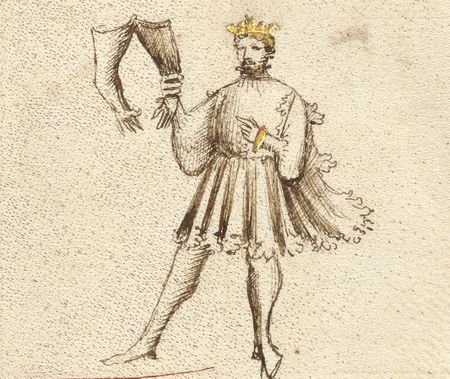
Because I triumph over those who fight with me,
I carry torn-off broken arms as a decoration.
[And I do not lie when I tell you that I have broken and dislocated many arms in my life.]
- Master Fiore Dei Liberi
Locking the arms of all opponents
In such a way that none can safely extend their right hand,
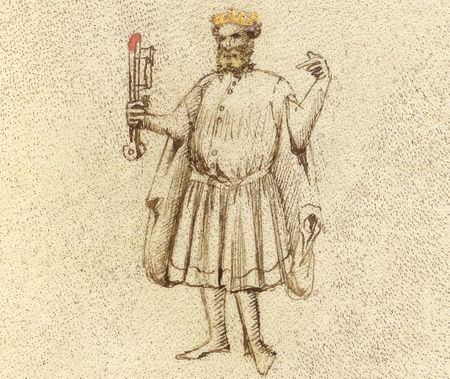
To show my success I carry a pair of keys in my hand.
- Master Fiore Dei Liberi
The body is organized in a certain way. Limbs bend in this direction, but not that. If you bend them forcibly in that direction, they are remarkably fragile. It's possible to cause immense pain and massive damage forcing limbs the wrong way.

There are a couple basic kinds of locks - keys and bars. For an example of a key, extend your arm straight out to the side, then - bending only at the elbow - point straight up. Now, try to rotate your arm at the shoulder to point backwards - you almost immediately hit the end of your range of motion.

If someone were to force your arm back like that, it would be immensely painful. They could apply a great deal of force, likely damaging your arm and almost certainly driving you forcefully to the ground.

The classic bar is the arm bar - this is basically forcing the elbow joint backwards by grasping the hand of an outstretched arm and applying force just above the elbow. Very little force is required to do massive damage to the elbow joint.

The Scholar executing an arm bar. Here, the hand of the outstretched arm is held in place by the Scholar's head (every part of the body is dangerous!) and the Scholar's arm is applying force behind the elbow. From here, the elbow can be stressed to breaking, or (more likely), the Student will bend to relieve the stress, and the Scholar could propel the Student's head into the ground.
The point with locks is applying force in a way that the victim cannot resist, either because (like an armbar) it's a 2-on-1 situation (two arms vs. one) or because the body has few muscles that can operate in that axis (like the key I described). Or both.

Various empty-hand defenses against weapons result in locks, for instance a two-handed defense against a vertical dagger strike can transition into the key I described, or an off-hand defense against a dagger attack from the high left side can be blocked and transitioned into an armbar.

Disarms
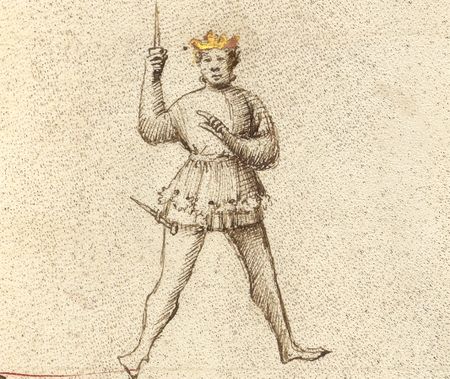
In my right hand I hold your dagger, and I gained it through my skill, which is so good that if you draw a dagger on me, I will take it from your hand. -Master Fiore Dei Liberi
While a popular TV/Movie trope is the "trick" sword move that disarms the enemy, this is highly unlikely. In order to take a weapon away, you have to get your hands involved.

This can arise from an empty-hand defense against an attack, or as a natural result of weapon play.

For instance, if an attack ends with the opponent's pommel in reach, it may be possible to grasp the pommel and twist it against the opponent's thumb, forcing the sword out of their hand while your sword ensures that they cannot land a hit while you're doing that.

An ideal empty-hand dagger defense ends with a disarm - one example would be stopping a blow coming from high on your left side and redirecting their energy past you and twisting their arm down and to your right. Executed properly, your forearm will press against the flat of their dagger and force it out of their hand.

Strikes

I can't find the exact passage at the moment, but Fiore reminds us that we should never forget striking with the empty hand - i.e. punches, kicks, knees, headbutts.

The ideal targets are the soft spots - the solar plexus, the neck, the nose, the groin, or places where great damage can be done - the knee, for example, can be devastated by a kick.

"Dirty" Techniques

Fiore was writing a book of war for people who would be engaged in lethal combat. As such, no effective technique is omitted or disallowed.

Someone choking you? Gouge their eyes.

Someone grappling close? Knee them in the groin (by all accounts, this is very effective regardless of their sex, despite what some may think).

Fish-hooks (digging a finger in between the teeth and the cheek) can be very effective at moving the opponent around, using the principle "where the head goes, the body follows".

Against a bear-hug from behind, grab a finger and twist it backwards until it breaks.

Someone's hand near your face? Bite their finger off.

Someone's face near your face? Bite their nose or ear off.

In a fight where you expect death is on the line, no technique can be rejected as "dirty" or "unsportsmanlike".

Integration with Weapons

I alluded to this in the section on disarms, and several times before, but the empty hand is always available, even when you're holding a weapon. It's totally possible for a winning move in a fight to be dropping your sword and attacking a vulnerable arm with a lock, or dropping your pinned poleaxe and moving in aggressively for a throw.

Summing Up

The human body is a very potent weapon with the right skill and training. I definitely know people that in a hypothetical fight to the death, I would not bet on me even if I had a sword and they did not, such is their skill at unarmed combat.

I also can't overstate how disorienting, painful, devastating some of these techniques are even in a friendly environment.

The empty hand - the first and last weapon of humanity. Don't underestimate it.

17 January 2014

Would Magic Change the World?

Following on from an interesting (if frustrating) discussion with Alexis at Tao of D&D, I'm going to talk about whether magic would change the world.

There are four scenarios worth considering, representing the ends of two "dials" on magic - how recent it is, and how prevalent/practical it is:
  1. Magic has always been around, but it's incredible rare/difficult.
  2. Magic has always been around, and it's very common/easy.
  3. Magic has only recently been discovered, and it's incredibly rare/difficult.
  4. Magic has only recently been discovered, and it's very common/easy.
Scenario 1 and 3 would result in a world much the same as our own. For whatever reason, there is some intrinsic barrier to widespread dissemination of magic. Perhaps (like Harry Potter) some people are Wizards and can do magic, and some people are not and can not and that's that. Perhaps magic requires certain ancient or otherworldly artifacts that cannot be duplicated, or materials of incredible scarcity. Perhaps magic has such catastrophic side effects that it is outlawed, or simply not practiced out of prudence.

There are any number of possible explanations, but the point remains - a small amount of magic, even if around for a great deal of time, would not have any significant effect.

Scenario 2 would be wildy, radically different from our world. As different as the world of a modern Briton is from an agrarian Brit living under the Norman yoke in 1088. Positing a world where anyone can do useful magic with the equivalent of, say, a six-week nightschool course would result in a world where everyone who's anyone retains one or more potent magic-users. Magic is used in industry, warfare, trade, diplomacy... Much as computers have transformed every facet of our current world, plentiful cheap magic would transform the ancient world, and therefore transform every subsequent age beyond recognition.

Instantaneous communication, teleportation, magical lie detection, purification of elements, transubstantiation of elements, battlefield artillery, mass production of wondrous objects... The possibilities are limitless, and it is difficult to make any kind of prediction about what such a world would be like. It would depend greatly on the exact types of magic that are feasible.

But to argue that plentiful, cheap magic, available over the long term, would not cause at least the degree of transformation that computers and industrialization did is insupportable.

Scenario 4 would be a world like our own transitioning into a different kind of world, like England at the beginning of the Industrial Revolution. Forward-thinking businessmen and princes would be making the most of the new-found magic in industry, commerce, and war. Most people would still be living pre-revolution lives.

Perhaps centuries of alchemical and astrological work were converging on a single solution to the problem of practical magic, and near-simultaneous discoveries were made in several places. Perhaps some planetary convergence opened rifts to another world. Perhaps powerful beings have returned to this realm, bringing magical potential with them.

None of this is Earth-shattering. I wouldn't think this is particularly controversial even (although I might be surprised). I don't think Alexis and I disagreed so much in our conclusions as our premises - if I understand correctly, he's thinking of a Scenario 1 world, and I'm looking at all the possibilities.

That said, we play a game. If you want to play a game where powerful, plentiful magic has always existed, but the borders of Europe are the same in 1088, the feudal system is in place in Norman England, and in every way the world mimics our own (but there's powerful, cheap magic everywhere), all power to you. It's a game. Do what works for your game!

But don't try and tell me that's a plausible historical scenario. It's not.

28 December 2013

Real-world Weapons: The Stick

Even more venerable than the spear, the stick is almost certainly the first weapon used by humanity. Only the stone is possibly older.

But, much like the spear, the stick suffers nothing in usefulness for its advanced age.

Master George Silver, writing ~1600, was of the opinion that the stick (the quarterstaff, in his case, a monstrous 8' ash shaft) was the "best weapon against all manner of weapons".

Description

The form of the stick varies perhaps the most amongst weapons. In its simplest form, it is simply a section of tree branch, perhaps two feet in length.

At its most advanced, we have the English quarterstaff (also known as the short staff), 6-8' in length, with steel or iron caps on the ends.

Other variations are the long staff, 12' in length; the walking stick (an exemplar being the Irish shillelagh), 2-3' in length with a weighted handle; and shorter staffs such as the 4' stick used in Jogo do Pau.

So, there is a great deal of variation in the stick - probably more than any other weapon.

Luckily for us, each type of stick weapon is similar to another weapon we've already discussed. The quarter staff is very similar to the spear. The shillelagh is similar to a mace. Short staffs are like inferior swords. The long staff is like the pike (which I have not discussed, as it is only relevant to formation combat). So, we can simply treat the differences between each type of stick and its closest relative.

Offense

The Quarterstaff

The quarterstaff is superficially similar to the spear, and there are similarities in their fighting techniques. However, the quarterstaff is typically somewhat longer than the spear, and it is typically gripper near the back end (as opposed to the more typical "half-staff" grip used on the spear, similar to the "half-sword" grip on the longsword).

The primary attack of the staff is the thrust, and for those doubting the power of a thrust from a staff, imagine a punch with more than double the power behind it being concentrated down to a steel or hardwood disk half the size of a fist. It's clear that a blow from a staff can be easily four or more times harder than a punch - easily enough to KO someone, collapse their windpipe, stun them, or rob them of their balance.

The staff can also strike, whipping the end quickly to hit the head, using the hips to generate power. The longer the staff, the more powerful the strike (but also the more power needed to generate the strike). The staff can perform all of the strikes the swords can - downwards, upwards (useful for groin shots), and side-to-side.

George Silver recommends using a combination, especially against a swordsman, as he finds that a swordsman has trouble defending against a thrust followed quickly by a strike (or vice versa).

The Shillelagh

A shillelagh is basically a big mace.

The Shorter Sticks

The main thing to remember when dealing with short sticks (2-4') is that, while they may be used much like swords, their capability for wounding is much less, and more attention needs to be paid to the continuation of the fight after a blow, as one blow will almost certainly never end the fight.

Defence
  
Silver is a big fan of the quarterstaff, and he is of the opinion that a man with a staff could best two equal opponents armed with swords, due to the massive reach advantage.

As with all weapons, an important part of staff fighting is grappling, perhaps even more so with stick weapons, as they lack the sharp parts that discourage the opponent from grabbing the end of the weapon. If the opponent grabs your staff and you can't get it back, you need to be immediately prepared to close to the grapple or flee. Or draw another weapon, although now your opponent has your staff, which is likely to be superior to anything else you are carrying!

26 December 2013

Castle Cost Calculator

I have linked the Excel file for calculating the cost of building castles in the sidebar for easy reference.

In case you missed it, I wrote a paper for Burgs and Bailiffs volume 2 on how to calculate the labour and materials used to build your dream castle.

The Excel file will allow you to type in the wall volume of the castle, and it will spit out the number of man-days needed to build it, how much cropland you'll need to feed all those labourers (or how much you need to pay them to buy their own food), and how much raw materials you'll need.

8 December 2013

Talking about Initiative Again

Initiative is floating around the blogosphere again. As far as I'm concerned, it's a closed matter.

Initiative belongs with alignment and the one-minute round in the dustbin of D&D history.

I've written previously about the futility of an alignment system, and how I run combat here:

http://spellsandsteel.blogspot.ca/2013/08/the-irrelevance-of-initiative.html


I've never seen a convincing explanation for why initiative is required. I'd like to deal with some of the reasons people think you should have an initiative system, and debunk them.

It allows for additional depth in character building - you can build a character with the advantage of always winning initiative!

First off, I decry the whole notion of "Character Building", but we'll leave that aside. This argument is typically seen from proponents of "board-game" systems like 3e/Pathfinder or 4e.

The real fallacy here is that having a fast initiative is somehow an advantage. As I've shown before, after the first round, initiative order is largely irrelevant, the turn cycle becoming cyclical with no well-defined start or end point. If you're re-rolling initiative every round, it becomes even more arbitrary.

Additionally, due to artifacts of a turn-based system, it can actually be a disadvantage to act first in certain situations.

It adds excitement to combat.

Personally, I don't find this, but I suppose that's a matter of opinion. I find it's an arbitrary and unrealistic rule that leads to thinking about the game rather than the game world. Personally, I try to make things as fast, fluid, and realistic as possible so that the game is always about the game world rather than the game rules.


It allows you to differentiate between weapons.

I suppose this is true, but it's not particularly realistic at the level of abstraction present in D&D. Over the course of a 10-second round, there's a lot of movement, and it's just totally irrelevant that you can make two or three quick, light slashes with a knife in the time it takes to make a full swing with a poleaxe.

And there are better ways to differentiate weapons - namely by function.

It allows you to differentiate characters.

Again, I suppose this is true, but not really realistic. I find it hard to believe that over a ten-second round, someone could be so much faster than someone else that they could consistently move first every time.

And since initiative order doesn't actually matter (or make sense), it's a distinction without a difference - it's a false differentiation.

It's more realistic.

This is just absurd. Again, at the level of abstraction in D&D, there's no meaningful "first" actor in a round. Ten seconds is just so long and so much can happen in a fight in that time, that a you-go I-go turn system is patently ridiculous from a realism perspective.


As a necessary component of a you-go-I-go turn system, there's nothing realistic about initiative.


3 December 2013

Real-world Weapons: The Poleaxe

The poleaxe (aka pollaxe, polax, poll-axe, pole-axe, pole-hammer, two-handed warhammer) was one of the most popular weapons of the high middle ages. Combining the virtues of the warhammer, axe, and short spear, it was a versatile weapon designed primarily for defeating plate armour.

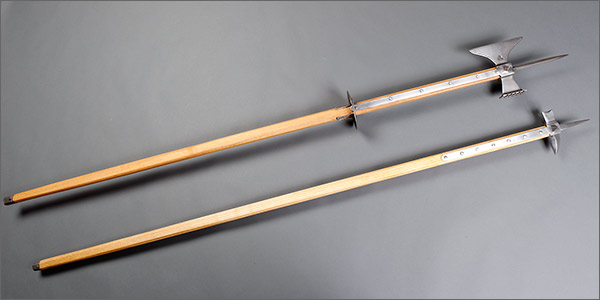
A hammer/axe poleaxe and a hammer/backspike poleaxe.
Description

The classic poleaxe, to my mind, is a six-foot square hardwood shaft with a hammerhead, backspike, topspike, buttspike, and sidespikes.

There are a few variations on the poleaxe, all of which revolve around the head. All will have some variation of axehead, hammerhead, and backspike. It could be axehead/hammerhead, hammerhead/backspike, or axehead/backspike. All have a long heavy-duty spike on the top, and a short spike on the bottom. Most will have a short, round hand-guard a foot or two below the head, and most will have short spikes on either side of the head.

One of the main differentiating features between the poleaxe and the very similar halberd are the langets on the sides (the metal strips running down from the head in the pictures above). A halberd head is typically forged out of a single piece, and attacked to the shaft like a spearhead via a tube and pin. The langets made the end of the weapon significantly stronger and more durable. They were part of the modular forged design of the poleaxe - each piece of the head was forged separately, which allowed a stronger construction than a single piece stretched and flattened out.

A poleaxe with an axehead would also have a smaller blade than a halberd, the better to defeat armour.

Similar Weapons

The halberd, lucerne hammer, and bec de corbin are all pretty much the same weapon as the poleaxe. The differences are basically just in head design - halberds always have axeheads and backspikes, lucerne hammers and bec de corbins always have hammerheads and backspikes.

For game purposes, I believe it's totally reasonable to treat all of the "complex" poleweapons as poleaxes - glaives, voulges, bills, partisans - all of those wacky stick/blade combos Gygax loved so much. Yes, they're all different, and all have different fighting styles, but there are distinct similarities that set them apart as a category.

Offence

The complex polearms, as exemplified by the poleaxe, are generally good for both utterly devastating two-handed swings and powerful thrusts. For an idea of the force involved, imagine smashing a melon with a baseball bat. Now imagine the baseball bat is twice as long and has a metal hammer head on the end.

The poleaxe can easily pulp the skull of an unarmoured man, the axehead can sever limbs, and the topspike can easily force its way between the links of chain mail. The topspike even has a chance of piercing through a breastplate.

The guards and actions of the poleaxe are something of a hybrid between the longsword and the spear. Its use is also something of a hybrid of the two, the main difference from the longsword being the extended reach and the ability to trap the opponent's weapon with the complex head. The main difference with the spear is the equal focus on striking and thrusting.

This guard is shared by the longsword, poleaxe, and major league baseball. Fiore calls it the "Guard of the Woman" (Posta di Donna). Much like a baseball player, the master is prepared to swing the axe around with a hip rotation, imparting devastating speed and power to the axehead.


Defence

As the poleaxe is typically used by a fully armoured man against another fully armoured man, grappling is integral to defense, as even with a poleaxe it's not always easy to down a man in full plate harness. It's not uncommon for two combatants with poleaxes to get their axeheads tangled on the ground and abandon their poleaxes and switch to their daggers or to attempting a throw.


A combination axe/grappling play. The scholar (on the left) has obtained a key (a type of arm hold) on his opponent, immobilizing him for a counterstrike.


Otherwise, much like with offense, poleaxe defenses can be similar to spear or longsword plays, either seeking to knock the opponent's weapon offline and thrust, or to beat aside and land a strike.


30 November 2013

Real-world Weapons: The Spear

The spear is, without a doubt, the most popular weapon of all time. From the dawn of time until WWII, the spear was issued in vast numbers to the common soldier. Surprised to hear that WWII soldiers were issued spears? Well, a rifle with a bayonet on it is functionally a short spear. Bayonet techniques owe a heck of a lot to medieval spear techniques, which, I'm sure, owed a lot in their turn to Stone Age spear techniques.

The reason for this is simple, and two-fold: the spear is cheap and easy to make, and it is extremely effective. I've said it before, and I'll say it again: it's not for nothing that the spear is the King of Weapons.

Description

I'm not sure this is really necessary, but...

The most basic spear is simply a sharpened stick, 5-8 feet long. At it's most advanced, the spear has a steel bladed head, 18" long, with lugs at the bottom of the head, a sharpened steel buttcap on the base, and a polished and lathed ash shaft 6-7 feet long.

The butt cap is an important point - many people don't realize that medieval spears have a sharpened steel spike covering the bottom. This makes the spear significantly more dangerous than if it only had the bladed head at the top.

A spearhead and buttcap.


The lugs allow some more parrying options, but they're certainly not necessary. Fiore's spear treatise doesn't show them except in the bit on a spearman vs. a horseman.

Spearhead with lugs.


Offence

Offence with the spear is really fairly simple - insert the point into the face of your opponent. Keep in mind, though, that the spear has a point on both ends. Since any defence against the spear will involve knocking the spearhead offline, a common tactic is to absorb and use the energy from that knock to spin the spear 180° and attack with the buttspike instead of the head.

Much of the stuff that applies to the halfsword (discussed in my earlier post on the longsword) also applies to the spear, as halfswording is really just turning your longsword into a 4-foot spear.

There is currently debate about whether the spearhead or spear shaft were used for striking as well as thrusting. There is little direct evidence for spears being used for striking, but arguments can be made for it. Viking sagas speak of "hewing spears" which were used for cutting. What these are is unknown - it is possibly just a normal spear, a spear with a long head, or something more like a glaive or naginata (i.e. a sword on a stick, as opposed to a spear, which is more like a dagger on a stick).

From handling spears, I can safely say that being bashed with the end would be pretty awful. I have little doubt that a solid hit from a spear could break bones in an unarmoured target.

There's also the fact that in Fiore's medieval fighting system there's a certain universality to the techniques - since the sword can be used like a spear, it's not unreasonable to see the spear sharing some techniques with the sword.

Wiser people than me disagree the the spear is used for bashing, though, so take the notion of bashing with the spear with a grain of salt.


Defense

Striking sideways with the spear definitely comes into play on the defensive. Most of Fiore's spear guards have the point off the line, pointing up, back, or to the side. The point-forward guards, while having the point forward, can still generate significant sideways force with a passing step.

The master (in the crown) stands in a typical defensive guard. His point is facing away from his opponent so that he can swing it around forcefully to knock his opponent's spear aside. Note that the combatants are depicted much closer than they would really be standing in combat!


The basic defence with the spear is to turn and swing your spear to strike the opponents weapon aside, ending up in a position where your point is directed at the opponents face or neck and your spear is between you and the opponent's weapon. If you over-parry (i.e. your spear keeps swinging past their face), you can keep that energy going and turn the spear right around and strike their face with the butt spike.

The master has successfully parried from the previous position. The momentum of the opponent's attack has carried him right onto the master's spear.