
 |
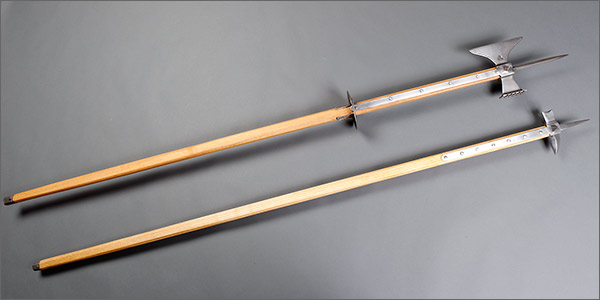
| A hammer/axe poleaxe and a hammer/backspike poleaxe. |
The classic poleaxe, to my mind, is a six-foot square hardwood shaft with a hammerhead, backspike, topspike, buttspike, and sidespikes.
There are a few variations on the poleaxe, all of which revolve around the head. All will have some variation of axehead, hammerhead, and backspike. It could be axehead/hammerhead, hammerhead/backspike, or axehead/backspike. All have a long heavy-duty spike on the top, and a short spike on the bottom. Most will have a short, round hand-guard a foot or two below the head, and most will have short spikes on either side of the head.
One of the main differentiating features between the poleaxe and the very similar halberd are the langets on the sides (the metal strips running down from the head in the pictures above). A halberd head is typically forged out of a single piece, and attacked to the shaft like a spearhead via a tube and pin. The langets made the end of the weapon significantly stronger and more durable. They were part of the modular forged design of the poleaxe - each piece of the head was forged separately, which allowed a stronger construction than a single piece stretched and flattened out.
A poleaxe with an axehead would also have a smaller blade than a halberd, the better to defeat armour.
Similar Weapons
The halberd, lucerne hammer, and bec de corbin are all pretty much the same weapon as the poleaxe. The differences are basically just in head design - halberds always have axeheads and backspikes, lucerne hammers and bec de corbins always have hammerheads and backspikes.
For game purposes, I believe it's totally reasonable to treat all of the "complex" poleweapons as poleaxes - glaives, voulges, bills, partisans - all of those wacky stick/blade combos Gygax loved so much. Yes, they're all different, and all have different fighting styles, but there are distinct similarities that set them apart as a category.
Offence
The complex polearms, as exemplified by the poleaxe, are generally good for both utterly devastating two-handed swings and powerful thrusts. For an idea of the force involved, imagine smashing a melon with a baseball bat. Now imagine the baseball bat is twice as long and has a metal hammer head on the end.
The poleaxe can easily pulp the skull of an unarmoured man, the axehead can sever limbs, and the topspike can easily force its way between the links of chain mail. The topspike even has a chance of piercing through a breastplate.
The guards and actions of the poleaxe are something of a hybrid between the longsword and the spear. Its use is also something of a hybrid of the two, the main difference from the longsword being the extended reach and the ability to trap the opponent's weapon with the complex head. The main difference with the spear is the equal focus on striking and thrusting.
 |
| This guard is shared by the longsword, poleaxe, and major league baseball. Fiore calls it the "Guard of the Woman" (Posta di Donna). Much like a baseball player, the master is prepared to swing the axe around with a hip rotation, imparting devastating speed and power to the axehead. |
Defence
As the poleaxe is typically used by a fully armoured man against another fully armoured man, grappling is integral to defense, as even with a poleaxe it's not always easy to down a man in full plate harness. It's not uncommon for two combatants with poleaxes to get their axeheads tangled on the ground and abandon their poleaxes and switch to their daggers or to attempting a throw.
 |
| A combination axe/grappling play. The scholar (on the left) has obtained a key (a type of arm hold) on his opponent, immobilizing him for a counterstrike. |
Otherwise, much like with offense, poleaxe defenses can be similar to spear or longsword plays, either seeking to knock the opponent's weapon offline and thrust, or to beat aside and land a strike.
